

Start Your Roof Repair Insurance Claim With the Right Evidence
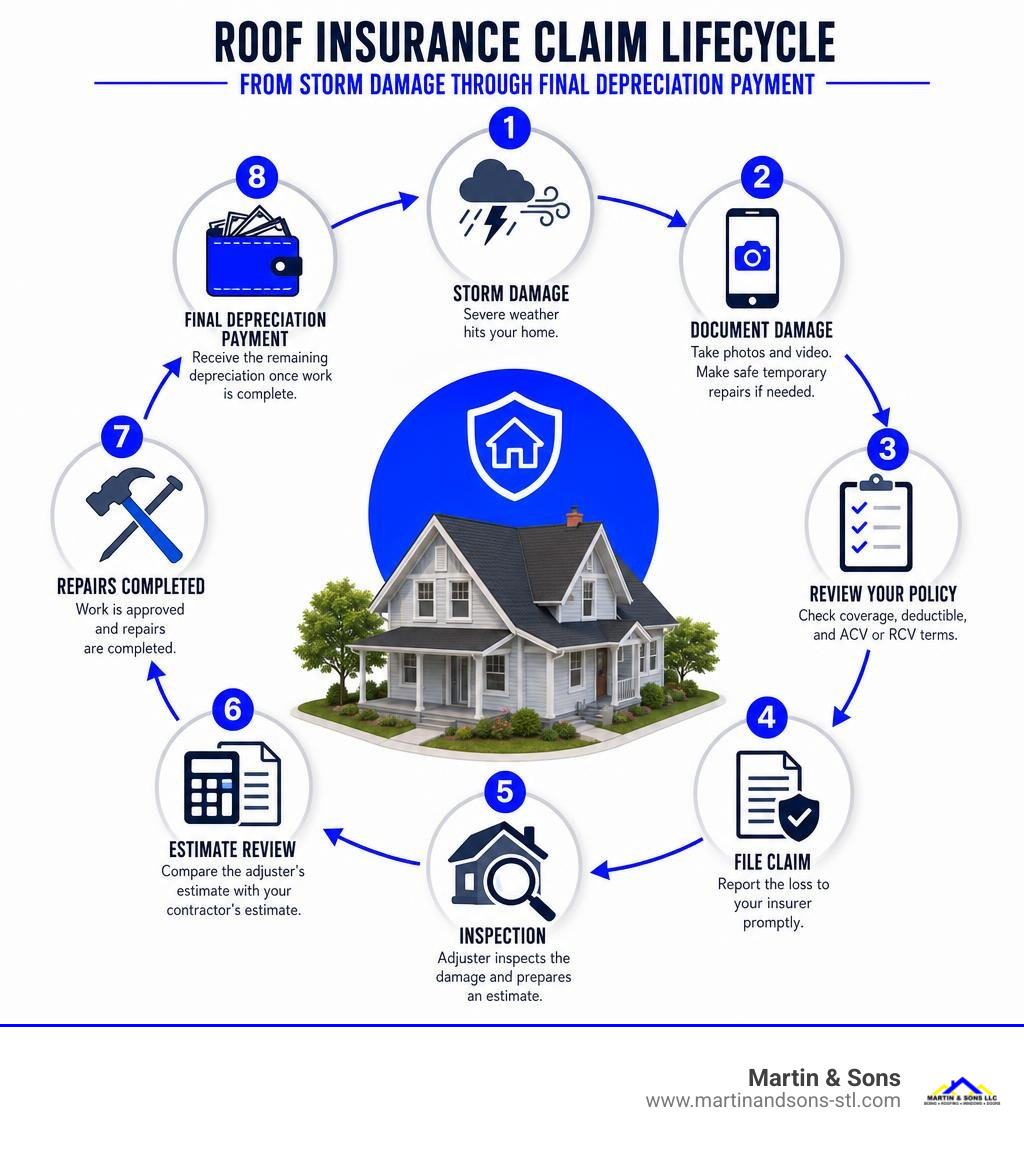
A roof repair insurance claim may pay for sudden damage from wind, hail, fire, or a fallen tree, but it usually will not pay for an old, worn-out, or poorly maintained roof. To protect your payout, take photos and video right away, make safe temporary repairs to stop further water damage, save every receipt, review your deductible and ACV or RCV coverage, then report the loss to your insurer promptly.
The big money questions are simple: What caused the damage? What does your policy cover? And does the repair cost exceed your deductible? Wind and hail deductibles can be a flat amount or a percentage of your home’s insured value, so the out-of-pocket amount may be much higher than expected.
A clear paper trail also matters. An insurer’s first estimate may miss damaged materials, code-required work, or local labor costs. That is why homeowners should compare it with a detailed contractor estimate before repairs begin.
I am John Martin of Martin & Sons, a family-owned company with more than 35 years of roofing industry experience. We help St. Louis homeowners understand the roof repair insurance claim process, document needed repairs, and complete roofing projects with no upfront deposit; gutter services are available only as part of a roofing project, because we are not a standalone gutter company.
Understanding Roof Insurance Coverage: What Is and Isn’t Covered
Navigating property insurance can feel like reading a contract written in another language. When severe weather hits your home, knowing exactly what your policy covers—and what it strictly excludes—is the first step to avoiding expensive surprises.
Covered Perils vs. Excluded Maintenance Issues
Standard homeowners policies (such as an HO-3 policy) operate primarily on an “open perils” framework for your home’s structure. This means structural damage is covered as long as it stems from sudden, accidental, and unexpected external events.
Commonly covered perils include:
- Severe Hail Impacts: Hailstones roughly 1 inch in diameter or larger that fracture shingle mats, bruise fiberglass layers, or cause severe granule loss.
- High Wind Events: Straight-line wind gusts (often 50 mph or greater) that lift, tear, or blow away asphalt shingles and flashing.
- Fallen Objects: Tree limbs or entire trees crashing into your roof structure during severe thunderstorms.
- Sudden Interior Leaks: Water damage resulting directly from a covered storm opening in your roof envelope.
- Fire, Lightning, and Weight of Ice/Snow: Sudden structural collapses or burns.
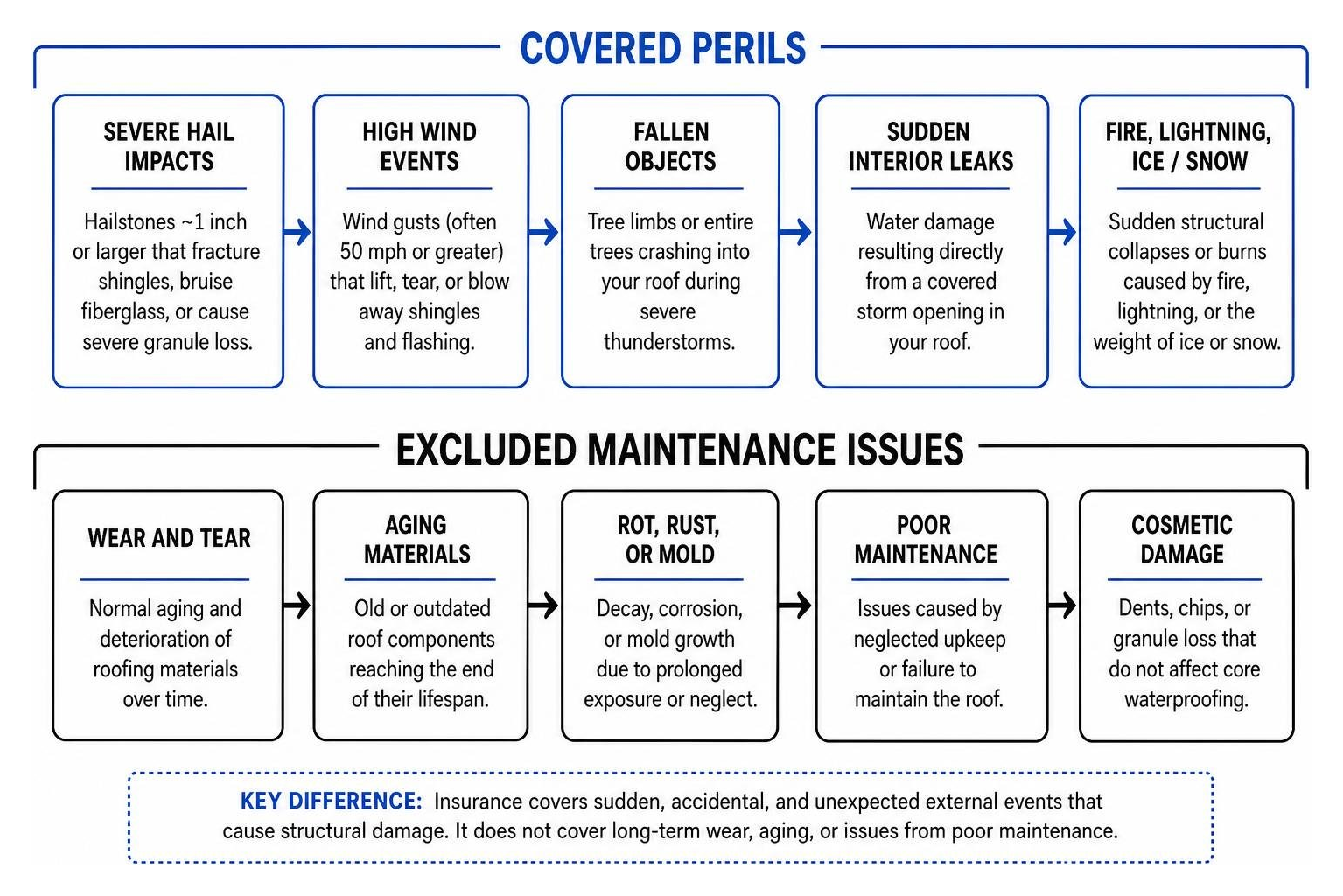
Conversely, standard insurance does not cover long-term wear and tear, aging materials, rot, rust, or mold growth. Policyholders often ask is roof damage covered by insurance when they discover a leak, only to learn that years of neglected maintenance or deteriorated flashing led to the failure. If an adjuster determines that an issue stems from deferred maintenance rather than a specific storm event, the claim will likely be denied.
Furthermore, many modern policies include “cosmetic damage exclusions.” If hail dents a metal roof vent or chips shingle granules without compromising the roof’s core waterproofing ability, the carrier may exclude repair payouts entirely. Catching structural damage early makes all the difference, which is why it helps to know the signs of roof damage you should never ignore before minor problems turn into major interior headaches.
Actual Cash Value vs. Replacement Cost Value Policies
The single most critical policy detail dictating your final payout is whether your roof is insured for Replacement Cost Value (RCV) or Actual Cash Value (ACV).
- Replacement Cost Value (RCV): Covers the full, modern market cost to repair or replace your damaged roof with materials of like kind and quality, minus your deductible. The insurer pays an initial actual cash payment up front, and then releases the held-back “recoverable depreciation” once your contractor completes the job.
- Actual Cash Value (ACV): Calculates the current replacement cost and subtracts depreciation based on the age and pre-existing condition of your roof. Under an ACV policy, that deducted depreciation is non-recoverable, meaning you must pay the difference out-of-pocket along with your deductible.
| Policy Feature | Replacement Cost Value (RCV) | Actual Cash Value (ACV) |
|---|---|---|
| Payout Basis | Today’s full replacement cost | Replacement cost minus depreciation |
| Depreciation Status | Recoverable after completed repairs | Non-recoverable (lost permanently) |
| Initial Check | ACV payment (minus deductible) | Final lump-sum ACV payment |
| Second Check | Released upon proof of completion | None |
| Homeowner Out-of-Pocket | Policy deductible only | Deductible + all accrued depreciation |
Consider an example where a storm ruins a 15-year-old roof with a 25-year lifespan, costing $15,000 to replace:
Under an RCV policy, once your contractor finishes installing the roof, your insurer issues a second check for the $9,000 in withheld depreciation, leaving your total out-of-pocket cost at your $1,000 deductible. Under an ACV policy, the $9,000 depreciation is permanently deducted, leaving you responsible for paying $10,000 ($9,000 depreciation + $1,000 deductible) to replace your roof.
Always check your declarations page during policy renewals, as many insurers automatically switch aging roofs from RCV to ACV without obvious fanfare.
Step-by-Step Process to File a Roof Repair Insurance Claim
Managing a property claim requires a clear, step-by-step strategy to make sure your damages are properly identified, documented, and paid out.

Documenting Damage for Your Roof Repair Insurance Claim
The success of your claim depends directly on your initial paper trail. Do not assume an insurance adjuster will catch everything.
- Pinpoint the Date of Loss: Check local storm reports and meteorological data to establish the exact day and time severe hail or wind occurred. Insurers verify this date against radar archives.
- Conduct Ground-Level Documentation: Walk your home’s perimeter safely. Capture date-stamped, wide-angle photos and close-up videos of missing shingles, dislodged fascia, damaged siding, and storm debris. Our ultimate guide to identifying and repairing wind damage provides helpful pointers on spotting subtle signs like creased or lifted shingle tabs.
- Inspect Peripheral Property: Document dents on gutters, air conditioning fins, metal patio furniture, mailbox tops, and window screens. Adjusters look at these soft metals to confirm hail trajectory and impact velocity.
- Record Interior Water Intrusion: Photograph moisture stains on ceilings, water pooling in attics, damp insulation, or peeling drywall tape inside closets and living areas.
- Mitigate Further Damage: Standard policies require homeowners to take reasonable steps to prevent secondary water damage. Arrange emergency tarping over exposed roof decking and save every mitigation receipt, which should be reimbursed under your claim.
- Consult Reputable Guides: Review a comprehensive roof claim filing guide to verify that your claim notifications comply with policy language before opening the file.
The Adjuster Inspection and the Role of Contractor Supplements
Once you open a claim, your insurer will assign an adjuster to inspect your property. Never let an adjuster inspect your roof alone if you can avoid it.

Independent or staff adjusters often carry heavy caseloads following large storms, sometimes inspecting five to seven roofs a day. They might spend only 15 to 20 minutes walking your roof, potentially missing creased shingle bonds, hairline shingle tears, or underlying decking rot. Having your roofing contractor present ensures that your contractor can:
- Walk the slopes alongside the adjuster and set up 10’x10′ test squares to count hail strikes.
- Highlight damaged components that are difficult to see from ladder height, such as cracked valley flashing or fractured pipe boots.
- Ensure all discussions adhere to standard regional building codes and manufacturer installation requirements.
Adjusters use estimating software like Xactimate to price the loss. However, these baseline estimates frequently omit essential scope items, such as starter strips, drip edge metals, ice and water shields, or proper dump and haul fees. In fact, when professional supplements are filed with documented photographic evidence and code citations, the average increase is approximately $6,000 over the initial insurance estimate.
For a complete walkthrough on how we pinpoint storm damage and prepare documentation for adjusters, explore our hail damage roofing claim and inspection process.
Managing Costs, Deductibles, and Maximizing Your Settlement
Understanding how insurance funds are handled protects you from unexpected expenses and helps ensure your roof is rebuilt safely to current standards.
How Deductibles Affect Your Roof Repair Insurance Claim Payout
Your deductible is the portion of the repair costs that you are legally required to pay out-of-pocket before your insurance policy pays anything. Policies typically use one of two deductible structures:
- Flat Dollar Deductibles: A fixed dollar figure (such as $1,000, $1,500, or $2,500) applied per loss event.
- Percentage-Based Wind/Hail Deductibles: A percentage (often 1% to 5%) calculated against the total insured value (Coverage A) of your home, not the cost of the roof damage.
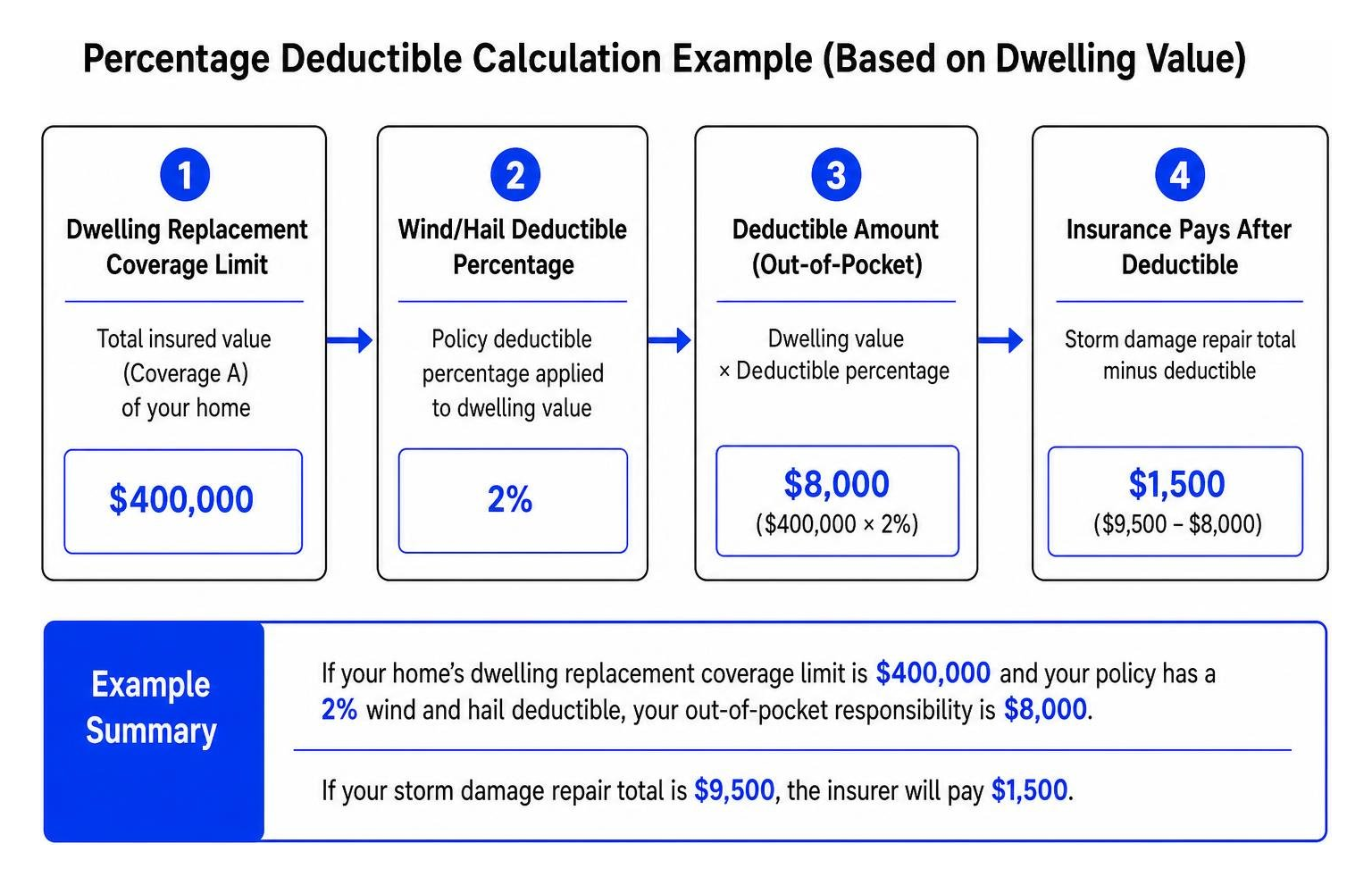
For example, if your home has a dwelling replacement coverage limit of $400,000 and your policy features a 2% wind and hail deductible, your out-of-pocket responsibility is $8,000 before the insurance carrier pays a single dollar. If your storm damage repair total comes in at $9,500, the insurer will pay only $1,500. Knowing these calculations in advance is crucial for accurate storm damage repair budget planning.
A Note on Deductible Scams: It is strictly illegal for any contractor to offer to “waive,” “absorb,” or “rebate” your insurance deductible. In almost every state, forgiving a policy deductible requires submitting inflated invoices to the insurance carrier, which constitutes felony insurance fraud. Reputable contractors will always require you to pay your legally mandated deductible.
Overcoming Denials, Age Restrictions, and Building Code Requirements
If an insurance company denies your claim or provides an insufficient partial repair offer, you do not have to accept the decision as final.
- Partial Repairs vs. Full Replacement: If an adjuster offers to patch a dozen shingles on a 15-year-old roof, an experienced contractor can conduct a “brittleness test.” Attempting to bend and nail old, brittle asphalt shingles adjacent to a repair area often tears the surrounding materials, proving the roof is structurally unrepairable and necessitating a full replacement.
- Discontinued Materials and Matching: If your damaged shingle model is out of production, your contractor can submit a sample to an independent lab (such as ITEL) for testing. When replacement shingles of like kind, quality, and color cannot be sourced, insurers are often obligated to replace the entire slope or roof to maintain visual uniformity.
- Building Code Upgrades (Ordinance or Law Coverage): Modern municipal codes require specific installation standards, such as full ice and water shield installation in valleys and along eaves, or structural decking re-nailing. If you carry Ordinance or Law coverage on your policy, your carrier must pay for these mandatory upgrades during a full replacement. For an in-depth breakdown of these policy mechanisms, read this industry analysis on roof replacement insurance coverage.
- Roof Age Milestones: Insurance carriers inspect aging roofs more aggressively. In many markets, roofs 15 years and older are subjected to mandatory underwriting reviews or shifted to depreciated schedules.
Avoiding Scams and Lowering Long-Term Premium Costs
After a major storm, neighborhoods are often visited by aggressive door-to-door sales crews. Protecting your investment means knowing how to spot bad actors and taking proactive steps to lower your ongoing insurance premiums.
Red Flags of Storm Chasers and Contractor Fraud
“Storm chasers” are transient contractors who follow severe weather systems from state to state, collecting quick insurance payouts and leaving town before warranty problems arise.
Watch out for these common warning signs:
- Out-of-State License Plates and Temporary Office Addresses: Unscrupulous operators rarely maintain permanent physical facilities or local roots.
- Demands for Immediate Upfront Cash Deposits: Asking for large sums of money before materials are delivered or work begins is a major warning sign.
- Requests to Sign an “Assignment of Benefits” (AOB): An AOB transfers your legal insurance rights and claim control directly to the contractor, leaving you powerless in negotiations.
- Offers to Cover Your Deductible: As noted, waiving deductibles is illegal insurance fraud.
- High-Pressure Door-to-Door Tactics: Pressuring you into signing immediate contracts on the spot before you have evaluated your options.
When vetting restoration professionals, review this guide on finding reliable storm damage restoration companies to ensure your chosen team has established local roots, verified general liability insurance, workers’ compensation coverage, and manufacturer certifications.
Premium Discounts: Impact-Resistant Shingles and FORTIFIED Standards
Replacing your roof after an insurance claim offers a great opportunity to upgrade your materials and lower your annual home insurance premiums:
- UL 2218 Class 4 Impact-Resistant Shingles: These advanced shingles feature polymer-modified asphalt or reinforced fiberglass backings designed to withstand impacts from 2-inch steel balls dropped from 20 feet. Many insurers offer annual premium discounts ranging from 5% to 25% for installing Class 4 systems.
- IBHS FORTIFIED Roof™ Standards: The Insurance Institute for Business & Home Safety (IBHS) sets rigorous construction standards—including sealed roof decks, ring-shank nails, and enhanced edge flashing—that provide superior wind and hail resistance while qualifying homeowners for meaningful insurance discounts in storm-prone regions.
Frequently Asked Questions About Roof Repair Insurance Claims
How long do I have to file a claim after a severe storm?
Most standard policies require you to provide “prompt notice” of damage to your carrier. Formal filing deadlines typically range from 180 days to one year from the exact date of loss, depending on your state and policy terms. Additionally, if your policy provides Replacement Cost Value, carriers commonly impose a strict deadline—often 180 to 365 days from the date of loss—for you to complete the repairs and submit final invoices to collect your withheld recoverable depreciation.
Will filing a roof insurance claim increase my monthly premiums?
A single claim filed for a sudden, weather-related “Act of God” (such as a tornado, hailstorm, or severe straight-line wind event) generally does not cause an immediate targeted rate hike on your individual policy the way an at-fault auto accident might. However, insurance carriers periodically adjust base rates across entire zip codes following widespread regional catastrophe events.
If your roof damage is minor and estimated at only a few hundred dollars above your deductible, paying out-of-pocket is often smarter than opening a formal claim that adds to your property’s claims history.
When should I hire a public adjuster or attorney for a roof claim dispute?
If your insurance carrier denies a legitimate storm claim or underpays a complex, high-value loss by tens of thousands of dollars, you have several dispute options.
- Contractor Supplements First: First, have an experienced roofing contractor submit detailed photographic proof, manufacturer repairability letters, and local building code requirements.
- Public Adjusters: If negotiations reach a complete standstill, a licensed public adjuster can represent your claim in exchange for 10% to 15% of the total settlement payout.
- Policy Appraisal Clause: Most policies contain an appraisal clause where an independent appraiser from each side, along with an agreed-upon neutral umpire, determines the final binding scope of loss without going to court.
- Insurance Attorneys: Legal counsel is typically reserved for instances of bad-faith insurance handling, improper claim denials, or statutory violations.
Conclusion
Filing an insurance claim for roof damage does not have to be an overwhelming experience. By collecting thorough photographic evidence, understanding the difference between Actual Cash Value and Replacement Cost Value, accounting for percentage-based deductibles, and having your contractor present for adjuster inspections, you can protect your investment and secure a fair settlement.
At Martin & Sons, we believe homeowners deserve complete transparency and peace of mind. We stand behind our work with industry-leading practices:
- No Upfront Deposits: You never pay a single dollar down before we begin work.
- Pay Only on 100% Completion: You pay only when the project is finished and you are completely satisfied with the craftsmanship.
- Lifetime Labor Warranties: Comprehensive protection backed by decades of proven local reliability.
- Best Prices Upfront: Honest, transparent estimates without high-pressure sales games.
Whether your home needs minor storm repairs or a complete roof replacement, we coordinate seamless installations from start to finish. When you replace your roof with us, we also ensure complete exterior protection by offering paired gutter replacements as part of your roofing build. Please note that Martin & Sons only provides gutter services when performing a roofing project; Martin & Sons is not a standalone gutter company.
If severe weather just hit your neighborhood, protect your property right away. Contact our team today for expert St. Louis storm damage restoration and get a clear, accurate assessment of your roof.