

Roof Preventative Maintenance Starts With Regular Checks
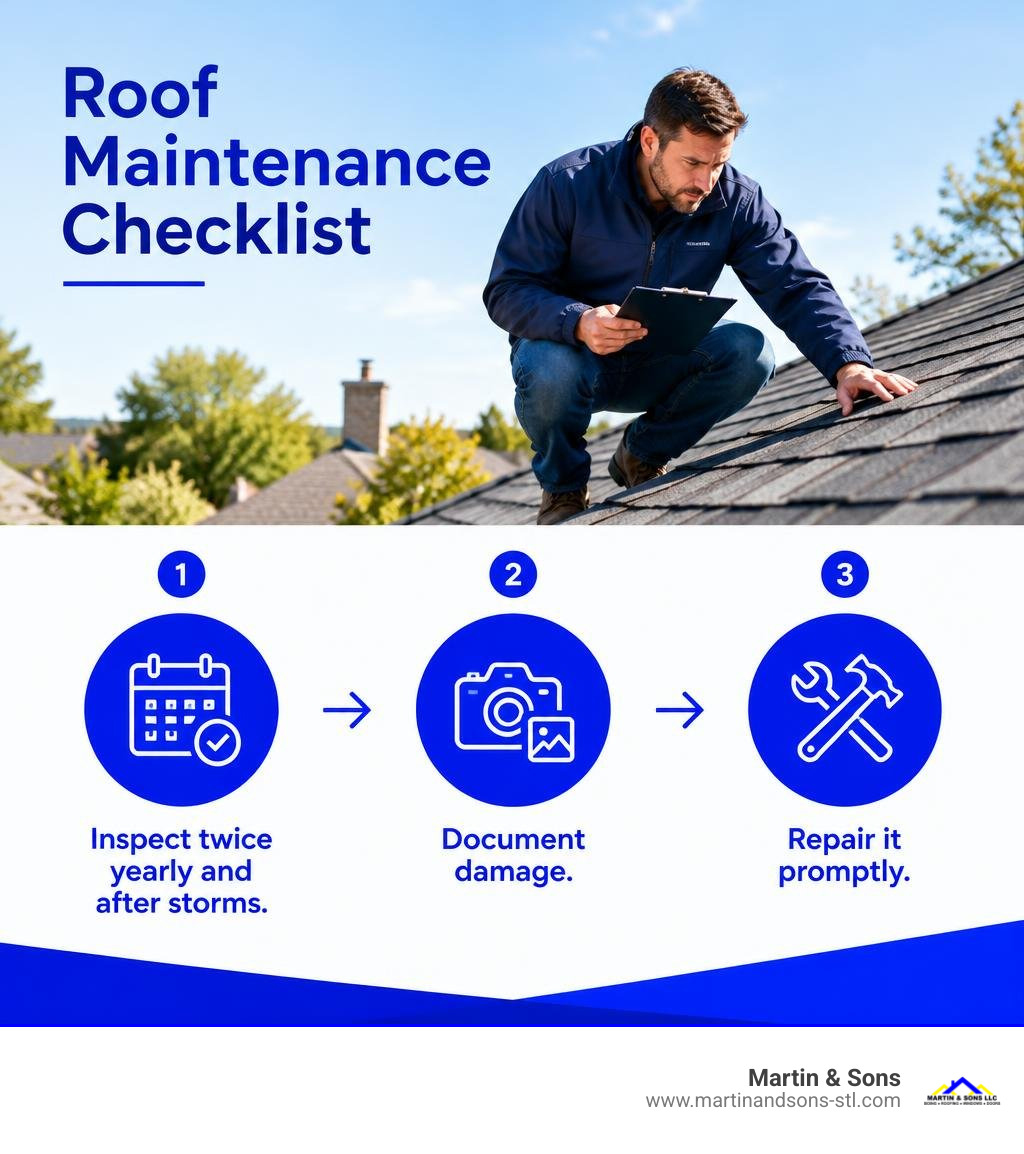
For roof preventative maintenance, check your roof each spring and fall and after major storms. From the ground, look for missing shingles, loose flashing, blocked drainage paths, and water stains inside your home. Keep dated photos, and ask a qualified roofer to repair damage promptly. Do not climb onto a steep or wet roof.
I’m John Martin of Martin & Sons, a family-owned business started in 1953. After more than 35 years in the industry, I know roof preventative maintenance starts with catching small problems before they become leaks.
Roof preventative maintenance terms explained:
Introduction

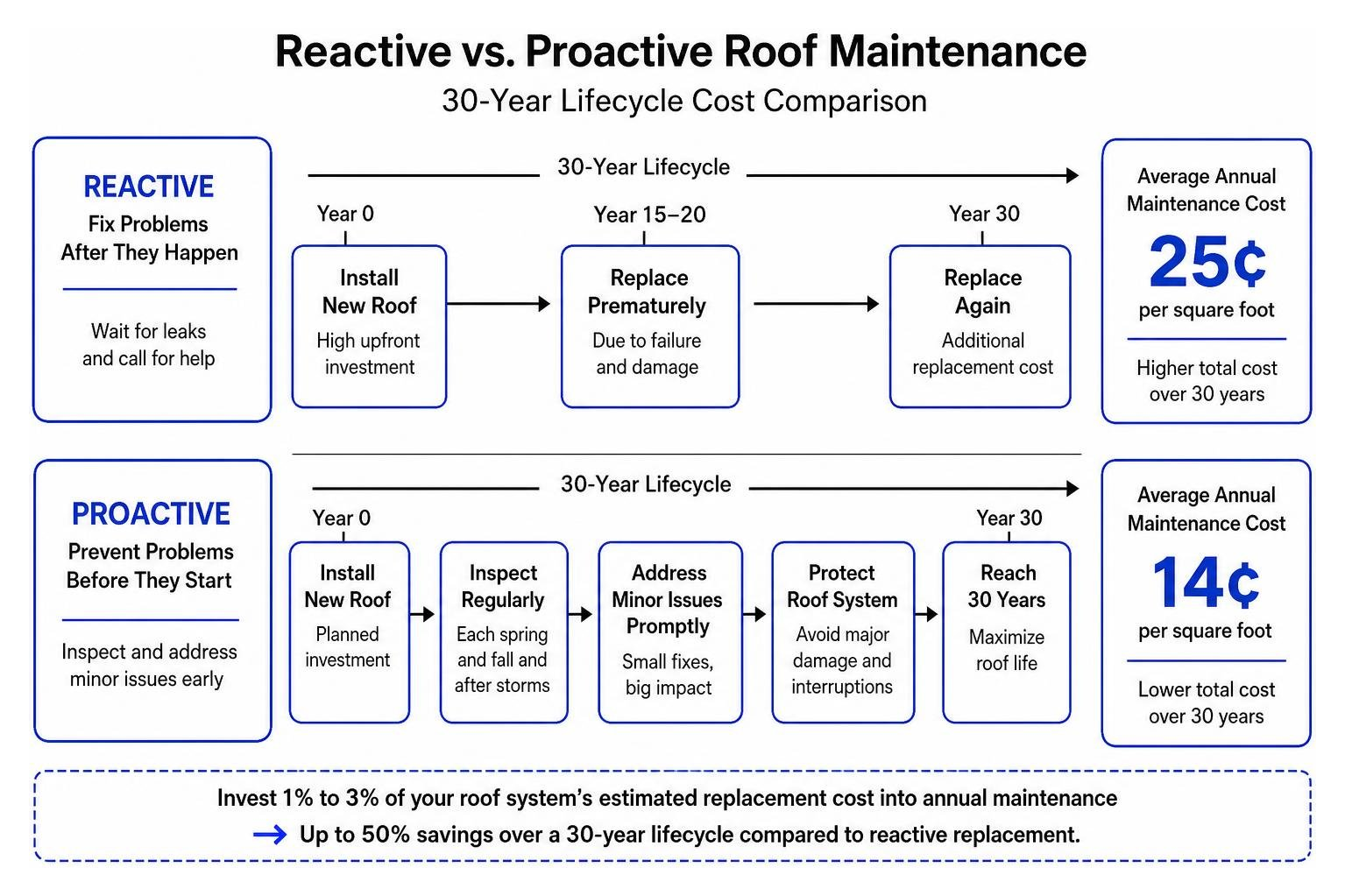
When it comes to building upkeep, treating your roof like an “out of sight, out of mind” feature is a gamble that rarely pays off. Property managers and homeowners who take a purely reactive stance—calling for help only after water drips onto an expensive conference table or living room rug—spend significantly more on upkeep. Industry data reveals that reactive owners spend an average of 25¢ per square foot each year on maintenance, whereas proactive owners who inspect and address minor defects early spend just 14¢ per square foot annually.
Investing just 1% to 3% of your roof system’s estimated replacement cost into annual maintenance can yield up to a 50% savings over a 30-year lifecycle compared to replacing failed assemblies prematurely every 15 to 20 years. Beyond sheer cost savings, structured care ensures complete warranty compliance and identifies sub-surface moisture long before structural framing rots or interior insulation collapses.
The Complete Guide to Roof Preventative Maintenance
An effective preventative maintenance program creates a reliable defense against environmental wear, structural movement, and unexpected weather events. By combining regular physical walk-throughs with verified diagnostic tools and organized records, we establish an ongoing protective cycle for any building.
Core Inspections and Timelines for Roof Preventative Maintenance
Setting a consistent schedule is the foundation of long-term roof preservation. Every property should undergo thorough reviews at least twice a year: once in early spring to gauge winter freeze impact, and once in early autumn before freezing temperatures arrive. Supplemental checkups should follow any severe hailstorm or high-wind event across communities like St. Louis, Florissant, St. Charles, and Chesterfield.
Understanding how often to schedule a roof inspection helps property owners catch subtle degradation early. Knowing the primary signs of roof damage you should never ignore keeps minor issues from becoming structural headaches:
- Persistent Ponding Water: Standing water that remains on a low-slope membrane for more than 48 hours after rainfall accelerates UV breakdown and indicates sagging decks or blocked drainage pathways.
- Membrane Distortions: Blistering, ridging, seam unbonding, or loose fasteners on single-ply and modified bitumen systems.
- Shingle and Granule Wear: Curling edges, severe granule shedding, missing tabs, or cracked asphalt layers.
- Interior Indicators: Mildew odors, peeling paint on top-floor ceilings, or discolored interior drywall.
For more technical background on common roofing inquiries, review the Frequently Asked Questions – ARCBAC.
| Strategy Element | Proactive Maintenance Program | Reactive Repair Approach |
|---|---|---|
| Inspection Cadence | Scheduled biannually (Spring/Fall) & post-storm | Only after active leaks penetrate interior |
| Average Annual Cost | ~14¢ per square foot | ~25¢ per square foot |
| System Lifespan | Full design life (25–30+ years) | Premature failure (15–20 years) |
| Warranty Standing | Full compliance via documented care logs | High risk of manufacturer claim denial |
| Disruption Level | Planned, minimal, non-invasive adjustments | Emergency dispatches and business downtime |
Advanced Non-Destructive Testing to Detect Hidden Moisture
Water is remarkably deceptive. It can enter through an opening the size of a pinhole, travel horizontally along structural purlins, and soak large sections of underlying polyisocyanurate insulation before a single drop appears indoors. Trapped moisture degrades thermal performance, encourages mold colonization, and corrodes metal decking.
Non-destructive testing (NDT) identifies moisture deep inside the roof assembly without cutting into the membrane. Common testing methods include:
- Infrared Thermography (ASTM C1153): High-resolution thermal cameras capture surface heat emission variations at dusk. Wet insulation retains stored solar heat longer than dry insulation, showing up as bright thermal anomalies.
- Nuclear Moisture Surveys: A specialized gauge emits calibrated neutrons into the roof layers. When hydrogen atoms (water molecules) slow these neutrons down, the instrument quantifies sub-surface moisture levels.
- Electrical Capacitance Testing (ASTM D7954): Handheld or rolling meters measure electrical impedance across the roof surface, identifying moisture through changes in dielectric constants.
- Electronic Leak Detection (ELD): High-voltage or low-voltage electrical currents pass across a grounded roof deck to locate membrane breaches with millimeter accuracy.
These evaluation techniques are vital for locating elusive roof leaks before wet substrate materials compromise structural load capacities.
Flashing, Sealants, and Drainage: Stopping Minor Leaks Early
Over 90% of roof leaks originate around perimeter edges and penetrations rather than open field areas. Expansion and contraction constantly strain the joints where vertical walls, HVAC curbs, conduits, and vent pipes meet horizontal roof decks.
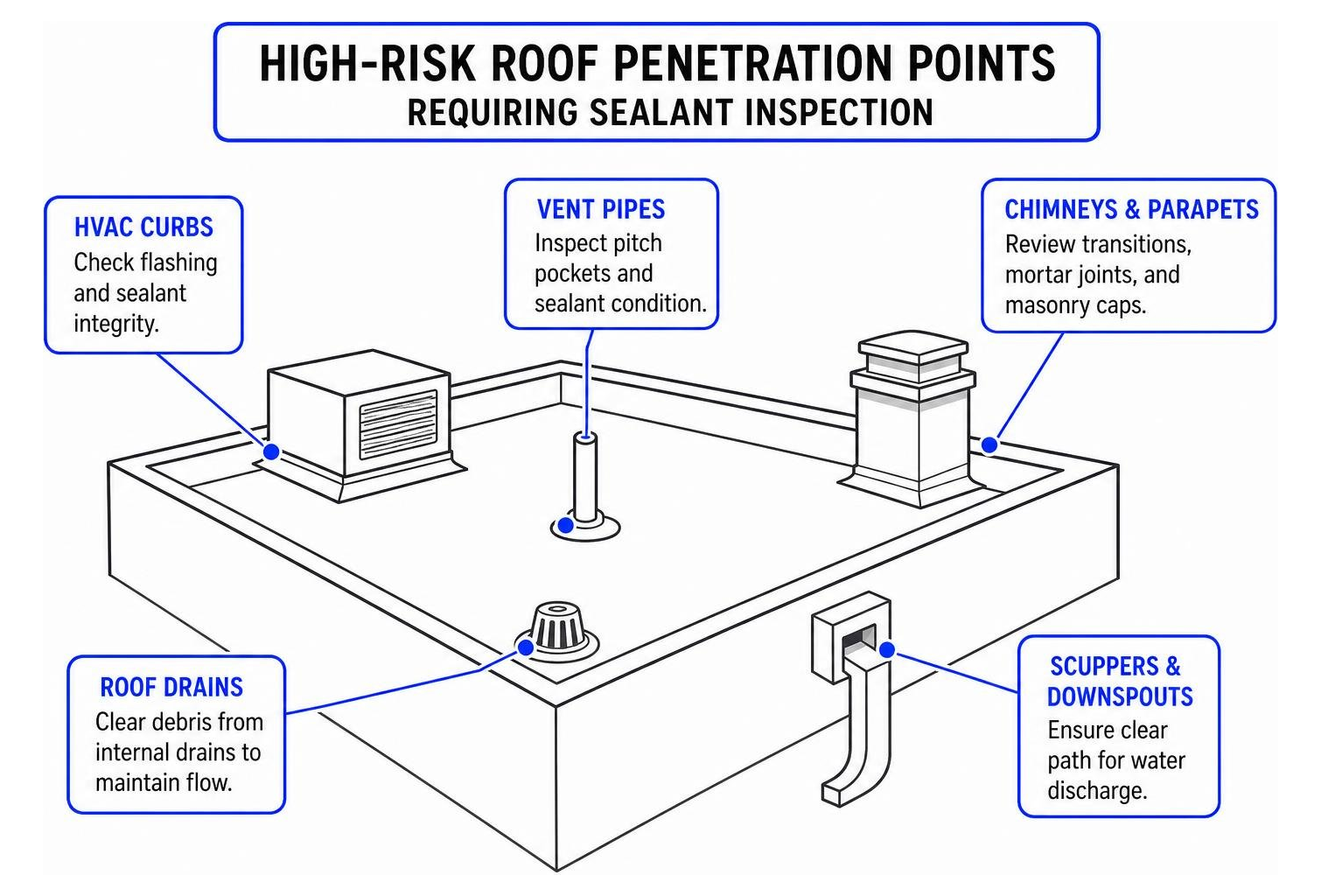
Routine care focuses on these critical transition points:
- Base and Counter-Flashings: Checking for pulled fasteners, open termination bars, or rusted sheet metal.
- Pitch Pockets: Ensuring potting sealants remain flexible without cracking, shrinking, or pulling away from penetration pipes.
- Chimney and Parapet Transitions: Reviewing mortar joints and masonry caps, making timely chimney and flashing repair essential to stop water entry behind wall assemblies.
- Drainage Assemblies: Clearing leaf debris, twigs, and silt from internal bowl drains, scuppers, downspouts, and gutters installed during roofing projects to maintain positive water flow.
- HVAC Condensation Lines: Verifying air conditioning drain pipes discharge straight into designated roof drains rather than pooling across open membranes.
Using manufacturer-compatible sealants and following installation standards outlined in resources like the Protecting Your Investment guide helps prevent minor joint separations from turning into emergency repairs.
Customizing Roof Preventative Maintenance for Different Systems
Different roofing materials react uniquely to environmental stresses. Customizing maintenance based on your specific system and local climate ensures optimal performance:
- Flat & Low-Slope Assemblies: Our guide to fixing flat roofs highlights the need to check seam welds, inspect parapet walls, and maintain open drainage paths.
- EPDM Rubber Systems: Proper maintenance for rubber roofing addresses membrane shrinkage, bridging at inside corners, and lap-seal separations.
- Standing Seam & Exposed Fastener Metal: Specialized metal roof repairs and leak prevention focus on replacing degraded neoprene fastener washers, resealing ridge caps, and treating surface oxidation.
- Ballasted Systems: Inspecting stone ballast for wind scour, redistributing displaced gravel, and keeping heavy aggregate clear of drainage screens.
- Rooftop Access Control: Limiting unmonitored foot traffic and installing dedicated rubber walkway pads between roof hatches and mechanical units to prevent puncture damage.
- Midwest Climate Stresses: Winter conditions bring heavy snow and freeze-thaw cycles. Promptly repairing winter freeze and ice dam damage protects soffits, eaves, and perimeter deck edges from rot.
For comprehensive guidelines on commercial single-ply and multi-ply system care, consult the manufacturer-published RS7395 JM Preventative Maintenance Brochure.
Partnering for Proactive Roof Care and Long-Term Warranty Protection
A successful maintenance program relies on clear roles between building owners and professional contractors. Facility managers and homeowners can easily handle basic tasks, such as visual ground checks, locking roof hatches to prevent unauthorized foot traffic, and logging storm dates. Certified roofing professionals handle hands-on membrane repairs, thermal moisture diagnostics, flashing installations, and safe roof-edge work.
Keeping a thorough maintenance logbook safeguards your investment. Manufacturer warranties explicitly require routine maintenance; failing to document regular care can void coverage for sudden leaks. Organized repair logs and dated photos also provide the clear documentation required for insurance adjusters following severe hail or wind events.
Understanding lifetime roofing warranties helps you track covered items while understanding the lifespan of your roof gives you a clear runway for long-term capital planning.
At Martin & Sons, we serve property owners throughout St. Louis, St. Peters, St. Charles, Florissant, Chesterfield, Creve Coeur, Maryland Heights, and O’Fallon. Since 1953, our approach has been simple and reliable: no upfront deposits, payment only upon 100% completion and satisfaction, backed by our lifetime labor guarantees and straightforward, honest pricing.
Protect your property’s value, extend your roof’s service life, and prevent costly water damage. Contact our local team today to schedule your comprehensive proactive roof preventative maintenance inspection.