

Why Proper 5 Inch Gutters Installation Protects Your St. Louis Home
5 inch gutters installation is the most common residential gutter project in the U.S. — and for good reason. Done right, it shields your foundation, siding, and landscaping from costly water damage. Done wrong, it leads to overflows, rot, and expensive repairs.
Here’s a quick overview of what proper installation involves:
- Inspect the fascia — check for rot or damage before mounting anything
- Calculate your drainage area — 5-inch K-style gutters handle up to 5,520 sq ft of roof area
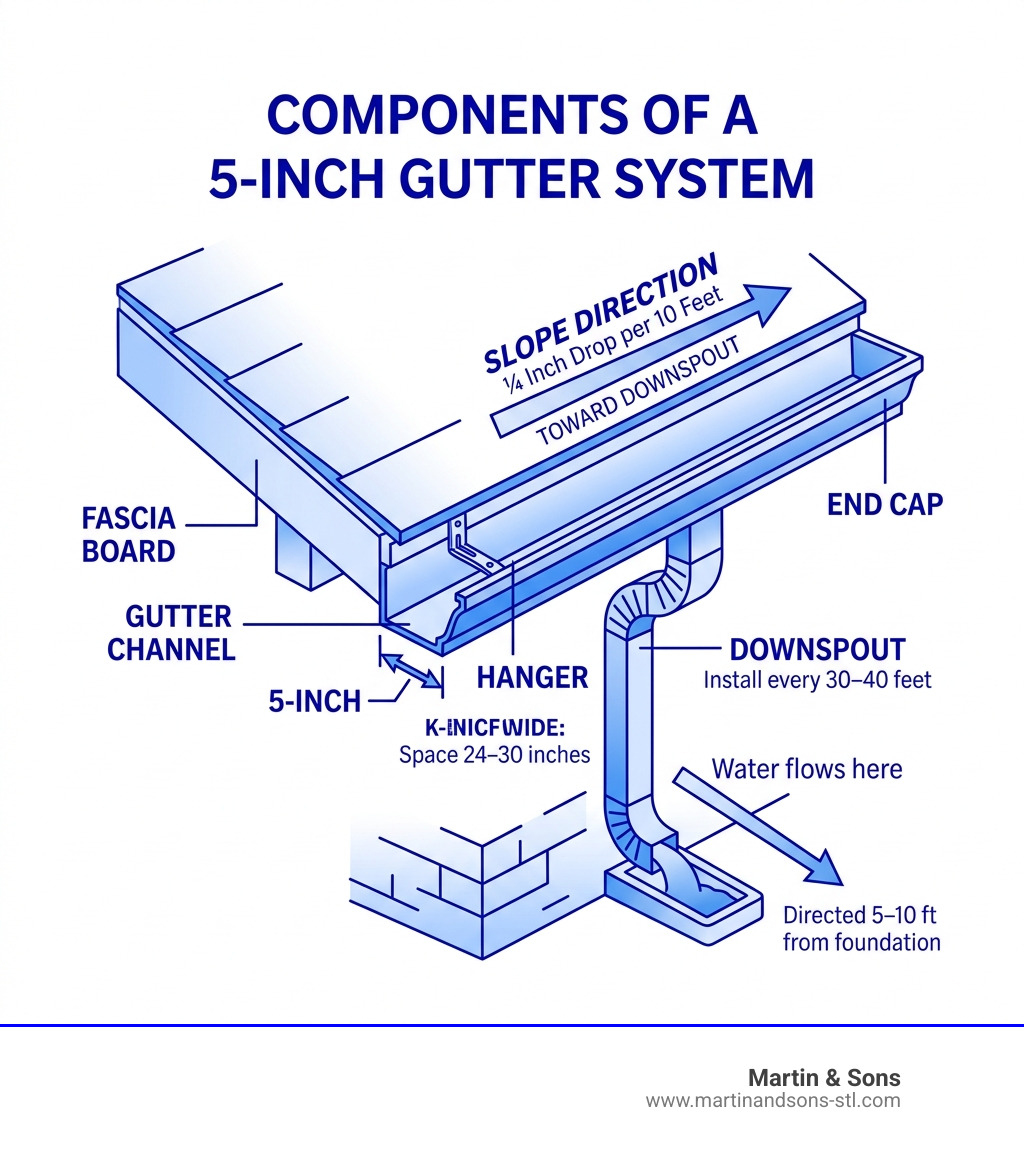
- Establish the correct slope — ¼ inch drop per 10 feet toward the downspout
- Space hangers every 24–30 inches — into rafter tails, not just the fascia
- Seal all joints and end caps — use high-quality gutter sealant throughout
- Install downspouts every 30–40 feet — directing water 5–10 feet from the foundation
- Test with a hose — check for leaks, pooling, and proper flow before calling it done
Five-inch gutters strike a practical balance between water-handling capacity and clean curb appeal for most St. Louis homes. But getting the details right — slope, hanger spacing, downspout placement — makes the difference between a system that lasts 20–30 years and one that fails after the first hard rain.
I’m John Martin, and with over 35 years of hands-on experience in home improvement — including countless 5 inch gutters installation projects across the St. Louis area — I’ve seen exactly what separates a long-lasting system from one that causes problems down the road. In this guide, I’ll walk you through everything you need to know to get it right.
The Essentials of 5 Inch Gutters Installation

When we talk about 5 inch gutters installation, we are usually referring to the “K-style” profile. This is the industry standard because its ogee shape mimics crown molding, providing a decorative finish that blends seamlessly into your home’s architecture. Unlike the older half-round styles, K-style gutters have a flat back that mounts flush against your fascia board, providing more structural rigidity and a larger water-carrying capacity.
A standard 5-inch gutter can hold approximately 1.2 gallons of water per linear foot. While that might not sound like much, it adds up quickly during a St. Louis thunderstorm. For those interested in historical aesthetics, the Half-Round 5″ Gutter | Capacity, Cost & Sizing Guide shows that while beautiful, half-round versions actually have a slightly lower capacity (about 3,980 sq ft of roof area at 1 inch of rain per hour) compared to their K-style cousins.
To ensure the water actually makes it into the gutter, we always recommend checking your Gutter Aprons because your roof deserves a better edge. These metal flashings prevent water from wicking behind the gutter and rotting your home’s structure.
Preparing for 5 Inch Gutters Installation
Before a single bracket is screwed in, we perform a rigorous fascia inspection. The fascia is the wooden board that runs along the edge of your roof. If it’s soft, crumbly, or showing signs of mold, it cannot support the weight of a water-filled gutter system. You can learn more about this in our guide on Professional Fascia Replacement What Homeowners Should Know.
Preparation also involves mapping out your downspout placement. A general rule of thumb for a 5-inch system is one downspout for every 30 to 40 feet of gutter run. If you have a particularly long roofline, you may need to “peak” the gutter in the middle and slope it toward downspouts at both ends.
Sizing and Climate Considerations
Is a 5-inch system right for you? In our experience across Florissant and Chesterfield, these gutters are the perfect fit for homes with roof sizes between 1,500 and 2,500 square feet.
St. Louis weather patterns can be unpredictable. We get heavy spring rains that can dump an inch of water in a very short time. A 5-inch K-style system is rated to handle up to 5,520 square feet of drainage area under standard conditions. However, if your roof is exceptionally steep (a high “pitch”), the water gains velocity as it sheds, which might require a more robust setup. We always calculate the “effective roof area,” which accounts for both the flat square footage and the pitch, to ensure your gutters won’t be overwhelmed.
Tools, Materials, and Cost Estimates for 2026
As of April 2026, the technology for 5 inch gutters installation has become more refined, but the core materials remain consistent. Most homeowners opt for aluminum because it is lightweight, rust-proof, and comes in over two dozen colors to match your siding.
When browsing our category/gutters page, you’ll see several material options:
- Aluminum: The gold standard. Lasts 20-30 years.
- Galvanized Steel: Stronger and better for heavy snow loads, though prone to eventual rust.
- Copper: The “forever” gutter (50-100 years), but significantly more expensive.
- Vinyl: The DIY favorite. It’s cheap but can become brittle in our Missouri winters.
To do the job right, you’ll need specific tools: a sturdy ladder, a chalk line for marking the slope, a cordless drill, tin snips for cutting sections, and high-quality Geocel sealant. We also exclusively use hidden hangers with integrated 3-inch screws, which provide a much cleaner look than the old-fashioned “spike and ferrule” method.
2026 Pricing and Labor Costs
In the current April 2026 market, the estimated cost for professional gutter installation ranges between $10.41 and $15.77 per linear foot.
For a typical home requiring about 150 linear feet of guttering, you can expect a total project cost between $1,500 and $2,400. This estimate includes materials, professional labor, and the removal/disposal of your old system. We always recommend adding a 10% overage to your material list if you are attempting this as a DIY project to account for mistakes or complex miters.
Material Pros and Cons
While we love aluminum for its 20-30 year lifespan and rust resistance, it is “softer” than steel. This means a heavy ladder leaned carelessly against an aluminum gutter can dent it. On the flip side, steel offers incredible structural rigidity but requires more maintenance to prevent the coating from failing. In the St. Louis climate, aluminum’s ability to withstand humidity without corroding makes it our top recommendation for 90% of residential projects.
Step-by-Step 5 Inch Gutters Installation Guide
Ready to get to work? Here is how we handle a professional 5 inch gutters installation from start to finish.
- The Chalk Line: We start at the end furthest from the downspout. We mark a “high point” about an inch below the drip edge. For every 10 feet of gutter, we drop the line by 1/4 inch. We then snap a chalk line to the downspout location. This ensures the water flows via gravity rather than sitting and stagnating.
- Assembly: It is much easier to join sections on the ground. We overlap the pieces by 2 inches, apply a generous bead of sealant, and secure them with rivets or screws.
- Hanger Spacing: This is where many DIYers fail. You must space your hidden hangers every 24 to 30 inches. In areas of the roof that catch more water (like valleys), we space them even closer.
- Hanging: Starting at the high end, we follow the chalk line, driving the hanger screws through the fascia and directly into the rafter tails for maximum support.
If you find that your home’s exterior is more complex than a simple ranch style, it might be time to look into The Best Local Siding And Gutter Companies For Your Home to ensure the technical aspects like “box miters” and “strip miters” are handled by pros.
Mounting and Securing the System
Securing the gutter isn’t just about the fascia. We ensure the screws bite into the solid wood of the rafter tails. This prevents the “gutter sag” that happens when heavy ice or wet leaves pull the system away from the house. We also ensure proper drip edge integration—the shingles should overhang the gutter by about 1/2 to 1 inch, directing water into the center of the trough.
Finalizing Your 5 Inch Gutters Installation
The final step is the downspout assembly. We use 2×3 inch outlets for 5-inch systems. Each downspout should be secured to the siding with straps and should include an elbow at the bottom. We recommend directing water at least 5 to 10 feet away from the foundation using extensions or splash blocks. Once everything is tight, we do the “hose test.” We run water at the high end and watch for leaks at the seams or pooling in the middle.
5-Inch vs. 6-Inch: Choosing the Right Capacity
One of the most frequent questions we get in O’Fallon and St. Peters is whether a 5-inch gutter is enough.
| Feature | 5-Inch Gutter | 6-Inch Gutter |
|---|---|---|
| Water Capacity | 1.2 Gallons/ft | 2.0 Gallons/ft |
| Max Roof Area | ~5,520 sq ft | ~7,960 sq ft |
| Downspout Size | 2×3 inches | 3×4 inches |
| Visual Profile | Sleek, standard | Bold, covers more fascia |
| Cost | Baseline | ~20-25% higher |
While 6-inch gutters hold 67% more water, they can look “oversized” on smaller ranch-style homes. However, if you have a very steep roof or a history of overflow, upgrading to 6-inch is a smart way of future-proofing your home against increasing storm intensities. To keep any system running smoothly, we highly recommend The Benefits Of Installing Gutter Guards, which keep debris out of the troughs and prevent the clogs that lead to overflows.
Maintenance and Common Mistakes to Avoid
Even the best 5 inch gutters installation will fail without maintenance. In St. Louis, we have plenty of oak and maple trees that love to drop “helicopters” and leaves into your system. We recommend a semi-annual cleaning—once in the spring and once in the late fall.
Common Mistakes to Avoid:
- Incorrect Pitch: If the gutter is level, water will pool, attracting mosquitoes and causing rust.
- Inadequate Downspouts: Trying to drain 60 feet of gutter into one 2×3 downspout is a recipe for a waterfall over your front door.
- Spacing Hangers Too Far Apart: If you go beyond 36 inches, the gutter will eventually sag under the weight of water or snow.
- Ignoring the Fascia: Mounting new gutters over rotted wood is like building a house on sand.
Frequently Asked Questions about 5-Inch Gutters
How much roof area can 5-inch gutters handle?
A standard 5-inch K-style gutter is designed to manage the runoff for up to 5,520 square feet of roof area. However, this capacity decreases if your roof is very steep or if you live in an area with extreme rainfall intensity. For most suburban homes in the St. Louis metro area, this capacity is more than sufficient.
Can I install 5-inch gutters myself?
Yes, you can buy 10-foot sectional gutters at big-box stores. However, DIYers often struggle with creating a leak-proof seal at the seams. Professional companies like us use a “seamless” machine that extrudes the gutter to the exact length of your house, eliminating seams entirely. Plus, working on a ladder is the leading cause of home accidents—safety should always be your first priority.
How many downspouts do I need for a 5-inch system?
We recommend one 2×3 inch downspout for every 30 to 40 feet of gutter. If your gutter run is 50 feet long, you should place a downspout at each end to ensure the water load is distributed evenly and doesn’t overflow during heavy downpours.
Conclusion
At Martin & Sons, we believe that your home deserves the best protection possible. Whether you are looking for a brand-new 5 inch gutters installation or need a complete roof overhaul, we are here to help our neighbors in St. Louis, St. Charles, and the surrounding areas.
We pride ourselves on our unique approach: no upfront deposits. You only pay when you are 100% satisfied with the completion of the project. With our lifetime labor warranties and best-price-upfront policy, you can rest easy knowing your home is in expert hands.
Don’t wait for the next big storm to find out your gutters aren’t up to the task. Schedule your professional gutter assessment today and let us give your home the edge it deserves.