
Why Roof Vent Types Matter More Than Most Homeowners Realize
Roof vent types are the different ventilation components installed on your home to move air through the attic — keeping it cool in summer, dry in winter, and protected year-round.
Here’s a quick breakdown of the most common types:
| Vent Type | Category | How It Works |
|---|---|---|
| Ridge vent | Exhaust (passive) | Runs along the roof peak; hot air escapes by convection |
| Soffit vent | Intake (passive) | Installed under eaves; draws cool air in |
| Box/static vent | Exhaust (passive) | Cut into roof deck; releases heat in localized spots |
| Turbine vent | Exhaust (mechanical) | Wind-powered spinning draws air out |
| Powered attic fan | Exhaust (active) | Electric or solar fan forces hot air out |
| Gable vent | Intake or exhaust | Installed in the wall at the roof peak; relies on wind |
A properly ventilated attic does three things: it controls moisture, regulates temperature, and extends the life of your roofing materials. Without it, you’re looking at mold, warped decking, ice dams, and energy bills that keep climbing.
Most homeowners don’t think about their roof vents until something goes wrong — and by then, the damage is already done.
I’m John Martin, owner of Martin & Sons, and with over 35 years of hands-on roofing experience in the St. Louis area, I’ve seen what poor ventilation does to a roof. Understanding roof vent types is one of the most important steps toward protecting your home long-term.
Understanding the Basics of Roof Vent Types
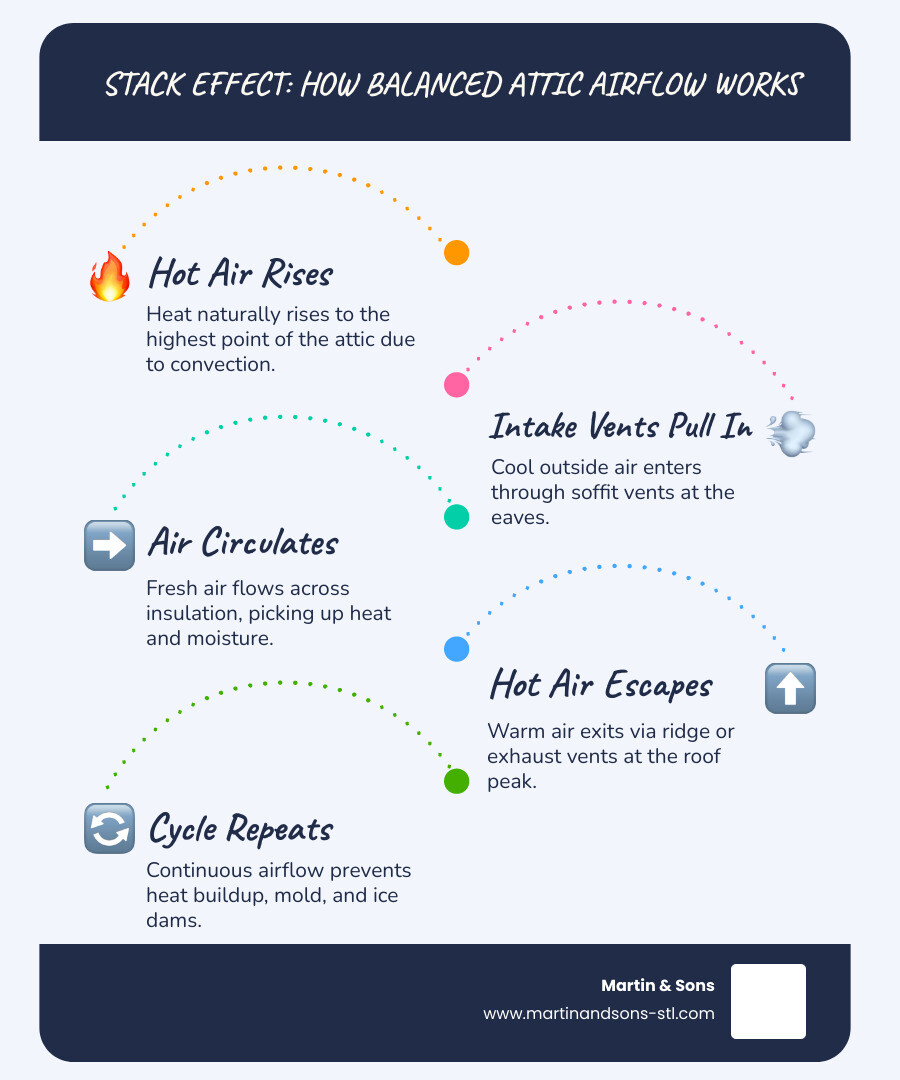
Before we dive into the specific hardware, we need to understand how air actually moves. Think of your attic like a set of lungs. For it to breathe properly, it needs to inhale and exhale.
Intake vs. Exhaust
A complete ventilation system requires two parts:
- Intake Vents: These are located at the lowest part of your roof (usually the eaves or soffits). They draw in cool, fresh air from the outside.
- Exhaust Vents: These are located at the highest point of the roof (the ridge or peak). Because hot air rises, these vents allow the trapped heat and moisture to escape.
If you have exhaust vents but no intake, your attic becomes a vacuum. It might even start “stealing” conditioned air from your living room through light fixtures or attic hatches, which drives up your Ameren or Spire bills.
Passive vs. Active Systems
Most of the roof vent types we install in St. Louis are passive. They rely on the “stack effect” (hot air rising naturally) and wind pressure to move air. Active systems, like powered fans, use electricity or solar power to force air out. While active systems move air faster, they have mechanical parts that can fail and require more maintenance.
The 1:300 Rule and Net Free Area (NFA)
In the roofing world, we use a standard called Net Free Area (NFA). This is the actual amount of open space in a vent that air can pass through (excluding the grates and screens).
The industry standard for April 2026 remains the 1:300 rule. This means for every 300 square feet of attic floor space, you need at least 1 square foot of net free ventilation area. For a balanced system, this should be split 50/50 between intake and exhaust.
For more details on how these systems integrate, read our overview of The Most Common Types Of Roof Vents.
Comparing the Most Effective Roof Venting Systems
Not every vent works for every roof. A sprawling ranch home in O’Fallon has different needs than a steep-pitched historic home in St. Charles.
| Feature | Ridge Vents | Soffit Vents | Box Vents | Turbine Vents | Powered Fans |
|---|---|---|---|---|---|
| Efficiency | Excellent | Essential (Intake) | Fair/Good | High (in wind) | Maximum |
| Cost | Moderate | Low | Low | Moderate | High |
| Durability | Lifetime | Lifetime | High | Moderate (moving parts) | Low (motor life) |
| Aesthetics | Invisible | Hidden | Visible | Highly Visible | Visible |

Ridge Vents: The Gold Standard for Exhaust Roof Vent Types
If your roof has a long, continuous peak, a ridge vent is almost always the best choice. It is installed by cutting a gap in the roof decking along the entire length of the peak and covering it with a low-profile vent that shingles sit on top of.
- Convection Power: Because it sits at the highest possible point, it utilizes the stack effect perfectly.
- Aesthetics: It blends in so well with the roofline that most people don’t even know it’s there.
- Weather Resistance: Modern ridge vents are designed with internal baffles that prevent rain and snow from being blown back into your attic.
For a deeper look at how these compare to other static options, see our Roof Vent Installation Guide Static Vs Turbine Vs Ridge.
Soffit Vents: Essential Intake for All Roof Vent Types
You can have the best ridge vent in the world, but it won’t do a thing if you don’t have intake. Soffit vents are installed under the eaves of your home.
- Cool Air Draw: As hot air leaves the top of the roof, it creates a vacuum that pulls cool air in through the soffits.
- Insulation Baffles: One common mistake we see in Florissant and Chesterfield is “blown-in” insulation blocking these vents. We install baffles (plastic channels) to ensure the air has a clear path from the soffit into the attic.
- Preventing Clogs: Over time, dust and spider webs can clog these vents. A quick spray with a garden hose or compressed air usually clears them right up.
Proper soffit ventilation is especially critical for Missouri homes during the winter to prevent the dreaded ice dam.
Box Vents (Static Vents)
Also known as “turtle vents,” these are square-shaped units installed over holes cut into the roof deck. They are great for roofs with complex shapes or short ridges where a ridge vent isn’t feasible. However, because they are localized, you often need several of them to reach the 1:300 requirement.
Turbine Vents (Whirlybirds)
These look like large metal mushrooms that spin in the wind. When they spin, they act like a vacuum, sucking hot air out of the attic. They are incredibly effective in breezy areas, but they do have internal bearings that can eventually squeak or seize up.
Powered Attic Fans
These use a motor to pull air out. They often come with a thermostat, so they only kick on when the attic hits a certain temperature (usually 100-110°F). In our experience in the humid St. Louis summers, these can reduce attic temperatures by over 20 degrees. However, they must be paired with plenty of intake vents, or they will pull air from your air-conditioned home.
How to Calculate Your Attic Ventilation Needs
Let’s do some quick “roof math.” Don’t worry, it’s simpler than it sounds.
- Measure your attic floor: If your home is 30 feet by 50 feet, you have 1,500 square feet of attic space.
- Apply the 1:300 rule: Divide 1,500 by 300. You need 5 square feet of total ventilation area.
- Convert to inches: Since vents are sold by “square inches of net free area,” multiply that 5 by 144. You need 720 square inches of total NFA.
- Balance it: You need 360 square inches of intake (soffits) and 360 square inches of exhaust (ridge or box vents).
In the St. Louis climate, getting this balance right is the difference between a roof that lasts 25 years and one that fails in 15. Improperly calculated ventilation leads to ice dams in the winter — where heat escapes, melts snow on the roof, and then refreezes at the cold eaves, forcing water under your shingles.
Signs of Poor Ventilation and When to Upgrade
How do you know if your current roof vent types aren’t cutting it? Your roof will usually tell you, but you have to know what to look for.
- Shingle Blistering: If your shingles look like they have small “popped” bubbles, they are literally being cooked from the inside out by attic heat.
- High Energy Bills: If your AC runs constantly but the upstairs is still sweltering, your attic is likely acting like a giant radiator.
- Warped Decking: Excessive moisture causes the plywood underneath your shingles to swell and “wave.”
- Attic Mold: If you see black or white fuzzy spots on your rafters, you have a moisture problem. This is common in homes where bathroom fans vent into the attic instead of through the roof.
- Ice Dams: If you see massive icicles hanging from your gutters in January, your attic is too warm.
If you notice any of these, it’s time for a professional inspection. We often find that homes have enough vents, but they are the wrong type or are improperly placed.
Frequently Asked Questions about Roof Venting
Can I mix different types of exhaust vents in one attic?
No. This is a very common mistake. If you have a ridge vent and a powered fan, the fan will pull air from the ridge vent (the closest opening) instead of drawing it up from the soffits. This “short-circuits” the system, leaving the rest of your attic stagnant and hot.
How much does it cost to install new roof vents in 2026?
Prices vary based on the roof vent types chosen, but here are some general estimates for the St. Louis area:
- Soffit Vents: $35 – $70 per vent.
- Ridge Vents: $10 – $15 per linear foot.
- Box Vents: $45 – $100 per unit.
- Powered Fans: $300 – $600 (including electrical work).
- Turbine Vents: $100 – $250 per unit.
Are solar-powered vents better than passive ridge vents?
Solar vents are great because they move air actively without increasing your electric bill. However, they only work when the sun is shining. Passive ridge vents work 24/7, 365 days a year, based on physics alone. For most Missouri homes, a well-designed passive system is more reliable and cost-effective over the long haul.
Conclusion
Choosing between different roof vent types isn’t just about following building codes; it’s about protecting your biggest investment. Whether you’re in Florissant, Chesterfield, or right here in St. Louis, your roof needs to breathe to survive our wild Midwest weather.
At Martin & Sons, we believe in doing things the right way. That’s why we offer best prices upfront, no deposits, and you only pay when you are 100% satisfied with the completion of the job. Plus, we back our work with a lifetime labor warranty.
If you’re worried about your attic health or think it might be time for an upgrade, don’t wait for a leak or a mold bloom. Check out our Roof Vent Installation Guide or give us a call today. We’ll help you find the perfect ventilation balance to keep your home comfortable for decades to come.