
Why House Siding Warranty Services Matter for Your Home Investment
House siding warranty services protect one of your home’s most critical exterior investments, typically covering both manufacturing defects and installation workmanship. When you invest $11,000 to $30,000+ in siding replacement for a typical 1,500-2,000 square foot home, understanding your warranty coverage isn’t optional—it’s essential.
Quick Answer: What House Siding Warranty Services Cover
| Warranty Type | What It Covers | Typical Duration |
|---|---|---|
| Manufacturer Warranty | Material defects, fading, cracking, warping | 30 years to lifetime |
| Workmanship/Labor Warranty | Installation errors, gaps, poor alignment | 1-10 years (or lifetime with select contractors) |
| Hail & Weather Protection | Damage from hail and severe weather events | Varies by brand |
| Fade Protection | Color change beyond specified units | 10-30 years |
The reality is simple: not all siding warranties are created equal. Some “lifetime” warranties are heavily prorated after just five years, meaning you’ll pay increasingly more out of pocket for repairs as time passes. Others exclude labor costs entirely, leaving you responsible for thousands in installation fees even when materials are replaced for free.
Research shows that siding replacement can return up to 80% or more of its cost at resale, but only if the warranty remains valid and transferable. According to the 2023 Cost vs. Value Report, this makes proper warranty coverage not just protection against defects—it’s a key factor in maintaining your home’s value.
Whether you’re considering vinyl, fiber cement like James Hardie, or advanced composite options like Everlast, understanding what’s covered, what voids your warranty, and how to file a claim can save you thousands in unexpected repair costs. And if something does go wrong—water damage repairs alone can cost $1,000 to $5,000+—knowing your warranty inside and out becomes critical.
Understanding the Two Pillars of House Siding Warranty Services
When we talk about protecting your home in the St. Louis area, we have to look at warranties as a two-part system. Think of it like a new car: the manufacturer guarantees the engine won’t explode because of a factory flaw, but the dealership guarantees they bolted the wheels on correctly.
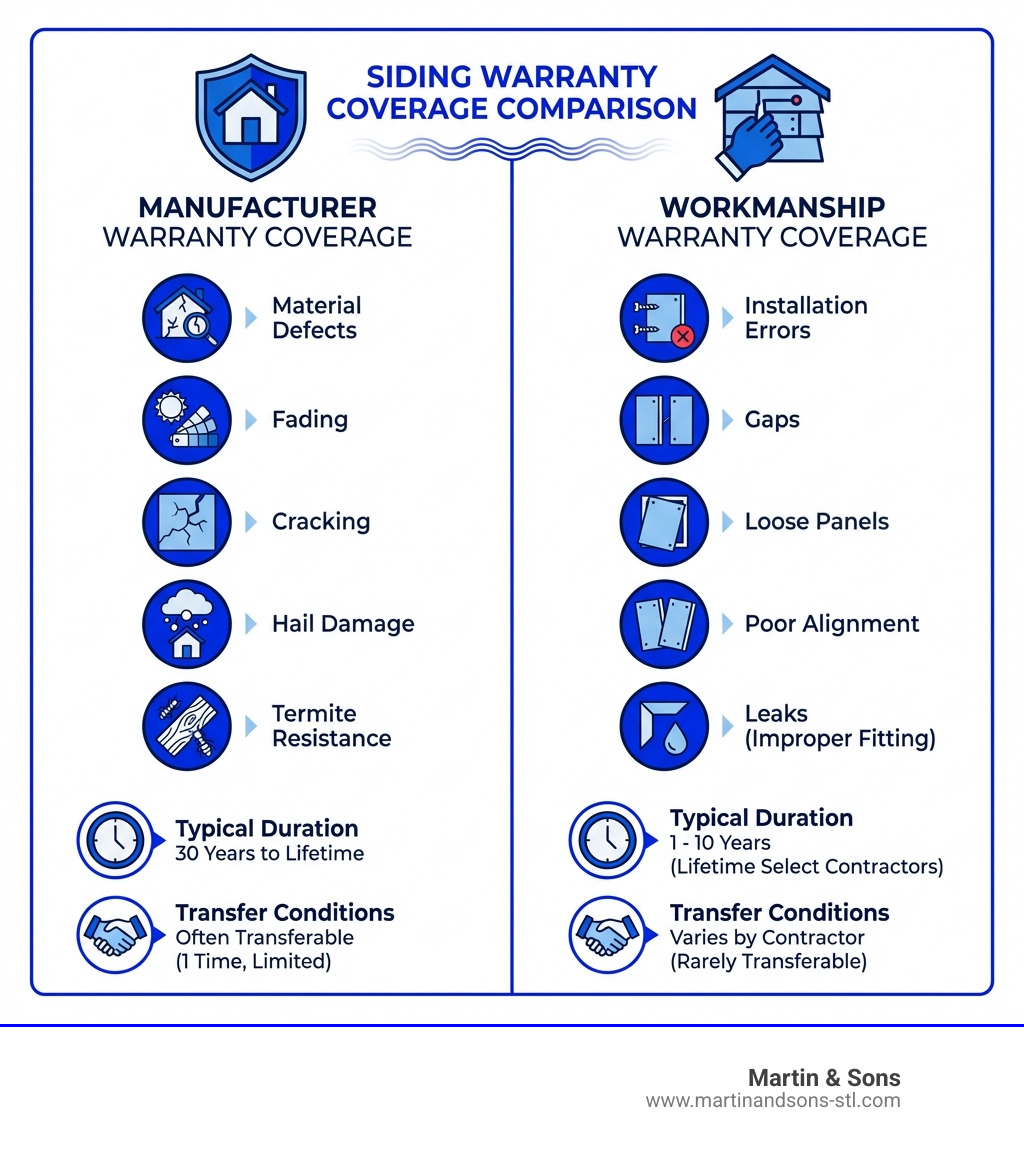
In siding, these two pillars are the Manufacturer Warranty and the Workmanship (or Labor) Warranty.
The manufacturer warranty is provided by the company that made the panels—brands like Alside, James Hardie, or ProVia. This coverage is strictly for the material itself. If the vinyl cracks because the chemical mixture was off, or if the fiber cement delaminates, the manufacturer steps in.
The workmanship warranty, however, comes from us—your local contractor. This covers the “human element.” Even the most expensive siding in the world will fail if it’s nailed too tight or if the flashing is missing. Because we believe in the quality of our crews across Florissant, O’Fallon, and Chesterfield, we provide a lifetime labor warranty. This ensures that if a panel comes loose or a leak develops due to how it was installed, you aren’t left holding the bill. Understanding how home siding repair can help identify these differences early can save you a massive headache later.
Manufacturer vs. Workmanship Coverage
It is a common misconception that one warranty covers everything. If your siding starts sagging two years after installation, is it a product defect or a labor error?
- Manufacturer Coverage: Focuses on “Material Defects.” This includes things like abnormal fading (measured in Hunter Units), rot, termite damage (for fiber cement), or spontaneous cracking.
- Workmanship Coverage: Focuses on “Installation Errors.” This includes buckled panels from improper spacing, moisture infiltration because of poor sealing, or panels blowing off in a standard wind storm.
The biggest “coverage gap” in the industry is labor. Many manufacturers will ship you new siding boards if yours are defective, but they won’t pay a dime for the crew to take the old ones off and put the new ones on. That is why a robust labor warranty from your contractor is the most valuable piece of paper you’ll receive during your project.
Lifetime and Transferable House Siding Warranty Services
The word “lifetime” is thrown around a lot in home improvement, but in legal terms, it rarely means “forever.” Usually, a “lifetime” warranty refers to the time the original purchaser owns the home.
One of the most important features to look for is transferability. If you sell your home in St. Peters or Creve Coeur, a transferable warranty allows the new owner to take over the protection. This is a massive selling point. For example, brands like Alside offer transferable limited lifetime warranties, while Everlast composite siding provides a lifetime warranty to the original owner that converts to a 50-year prorated warranty for the next person.
You can find more specific details on how these terms are structured by reviewing CertainTeed: Warranty Information, which outlines how coverage often diminishes (prorates) over time.
Coverage and Exclusions: What’s Really Protected?
To truly review house siding warranty services, you have to look at the fine print regarding specific types of damage.
| Feature | Vinyl Siding | Fiber Cement (Hardie) | Composite (Everlast) |
|---|---|---|---|
| Fading | Covered (usually >4 Hunter Units) | 15-year finish warranty | Covered (>4 Hunter Units) |
| Hail | Often covered (brand dependent) | Covered | Covered (if insurance doesn’t) |
| Cracking | Covered (defects only) | Covered | Covered |
| Termites | Naturally resistant | Guaranteed resistant | Guaranteed resistant |
Many high-end products now include “Color Keeper” or anti-fade technology. For instance, ProVia defines “fade” as a loss of more than four standard color units. If your siding turns from deep blue to a chalky grey within five years, that’s a warranty issue.
Common Warranty Exclusions
No warranty covers everything. If a tornado levels your house, that’s an “Act of God,” and you’ll be talking to your insurance agent, not the siding manufacturer. Common exclusions include:
- Acts of Nature: Floods, lightning, and extreme wind (usually above a certain MPH).
- Improper Storage: If the siding sat in a puddle on the job site for three weeks before being installed.
- Structural Settlement: If your home’s foundation shifts and cracks the siding, that isn’t the siding’s fault.
- Heat Distortion: Believe it or not, reflections from high-efficiency windows (yours or your neighbor’s) can melt vinyl siding. This is almost always excluded.
If you notice damage and aren’t sure if it’s covered, getting more info about siding repair from a professional can help you determine if you have a valid claim or if you need to call your insurance company.
Maximizing Your House Siding Warranty Services Through Maintenance
Most warranties have a “hidden” requirement: you have to take care of the product. If you let mold and mildew eat away at the finish for a decade, the manufacturer might deny a fading claim.
- Cleaning: Use a soft brush or cloth and a garden hose.
- Avoid Pressure Washers: High-pressure water can force its way behind the panels, leading to rot and voiding your warranty.
- Caulk Maintenance: For materials like fiber cement, you are often responsible for replacing the caulk when it wears out to prevent water infiltration.
- Approved Cleaners: Use only what the manufacturer suggests (like Fantastic or Soft Scrub for certain composite brands). Avoid organic solvents or harsh chemicals.
Comparing Warranty Terms by Siding Material
The material you choose for your Maryland Heights or O’Fallon home dictates the “flavor” of warranty you’ll receive.
Vinyl and Composite Durability
Vinyl is the king of the “Lifetime Warranty.” Most manufacturers offer a limited lifetime warranty that covers peeling, flaking, and rusting. However, these are almost always prorated. This means after year 10, the manufacturer might only cover 60% of the material cost, and by year 25, only 10%.
Advanced composites, like Everlast, take it a step further. They often guarantee against rot and delamination for life. Because these materials are engineered to be tougher than standard vinyl, their warranties are often less “aggressive” with proration schedules. You can see why many homeowners choose these options by looking at the benefits of vinyl siding installation.
Fiber Cement and Steel Specifics
James Hardie fiber cement is a local favorite in St. Louis, and for good reason. They offer a 30-year limited product warranty. What makes them unique is their 15-year finish warranty on factory-applied coatings (ColorPlus Technology).
Steel siding warranties focus heavily on “hail perforation” and “chalking.” While steel is incredibly durable, the warranty ensures that the paint won’t flake off and the metal won’t rust through. Fiber cement warranties also specifically mention protection against woodpeckers and termites—two things that can be a real nuisance in Missouri!
How to File a Claim and Avoid Voiding Coverage
Filing a claim can feel like a part-time job if you aren’t prepared. The key is documentation. The moment you see an issue, start a paper trail.
Required Documentation for Claims
If you need to file a claim with a company like LP SmartSide or CertainTeed, they will typically ask for:
- Proof of Ownership: A deed or property tax report.
- Installation Date: A building permit or the original contract from us.
- Photos: You’ll need “full view” photos of all sides of the house and “close-up” photos of the specific defect.
- Samples: Sometimes, the manufacturer will ask you to cut out a small piece of the damaged siding and mail it to their lab for testing.
You can find the specific portals for these tasks at sites like Warranty Claims.
Steps to Avoid Voiding Your Warranty
The fastest way to lose your protection is to hire an “unauthorized” or “unqualified” installer. Most manufacturers stipulate that the product must be installed according to “industry standards” and “local building codes.”
- Hire Certified Pros: Use installers who know the specific requirements for the brand.
- Don’t Paint Over It: Painting vinyl or composite siding that wasn’t designed to be painted will almost instantly void your warranty.
- Report Quickly: Most warranties require you to report a defect within 30 to 60 days of discovering it. If you wait a year, they can deny the claim.
Understanding why choose a professional installer is about more than just a straight row of siding—it’s about protecting your legal right to a replacement if the product fails.
The Impact of Warranties on Home Value and ROI
In the St. Louis real estate market, a home with a “fully transferable lifetime warranty” on the siding is worth significantly more than one without it. Siding replacement generally offers an 80% return on investment, but that number assumes the siding is in good condition.
A strong warranty provides “peace of mind” to a buyer. When they see a 30-year transferable warranty from James Hardie or a lifetime labor warranty from us, they know they won’t be hit with a $20,000 surprise repair bill three months after moving in. Furthermore, high-quality insulated siding (like ProVia CedarMAX) can even come with energy-savings warranties that guarantee lower utility bills, which is a huge bonus for boosting energy efficiency.
Frequently Asked Questions about Siding Warranties
What does a “lifetime” siding warranty actually mean?
In most cases, it means the “reasonable expected lifespan” of the product while you own the home. For vinyl, this is often 50 years. It’s important to check if the “lifetime” coverage is non-prorated (full value) or prorated (value drops every year).
Can I transfer my siding warranty if I sell my house?
Usually, yes, but there is a catch. Most brands require you to notify them in writing within 30 days of the house sale. There may also be a small transfer fee. Once transferred, the warranty often converts from “lifetime” to a “50-year prorated” term starting from the original installation date.
Does homeowners insurance cover what warranties don’t?
Warranties cover defects (the product failed). Insurance covers accidents (the wind blew a tree onto your house). If a hailstorm destroys your siding, your insurance usually pays for it. However, some warranties (like Everlast or ProVia) actually include hail protection to cover your deductible or provide materials if your insurance doesn’t cover the full cost.
Conclusion
At Martin & Sons, we’ve seen every type of siding issue imaginable across St. Louis and St. Charles. We know that a warranty is only as good as the company standing behind it. That is why we offer lifetime labor warranties and a no upfront deposit policy. We want you to be 100% satisfied before we ever take a payment, ensuring that your installation is done right the first time so you never have to worry about “voiding the fine print.”
If you’re ready to protect your home with the best products and the most reliable house siding warranty services in Missouri, we’re here to help. From initial consultation to final walk-through, we’ve got everything you need for your siding project. Contact us today for a free estimate and let’s get your home the protection it deserves!