What Cement Board Shake Siding Actually Is (And Why Homeowners Are Choosing It)
Cement board shake siding is a fiber cement product engineered to look like traditional cedar shake — without the rot, pests, or constant upkeep that comes with real wood.
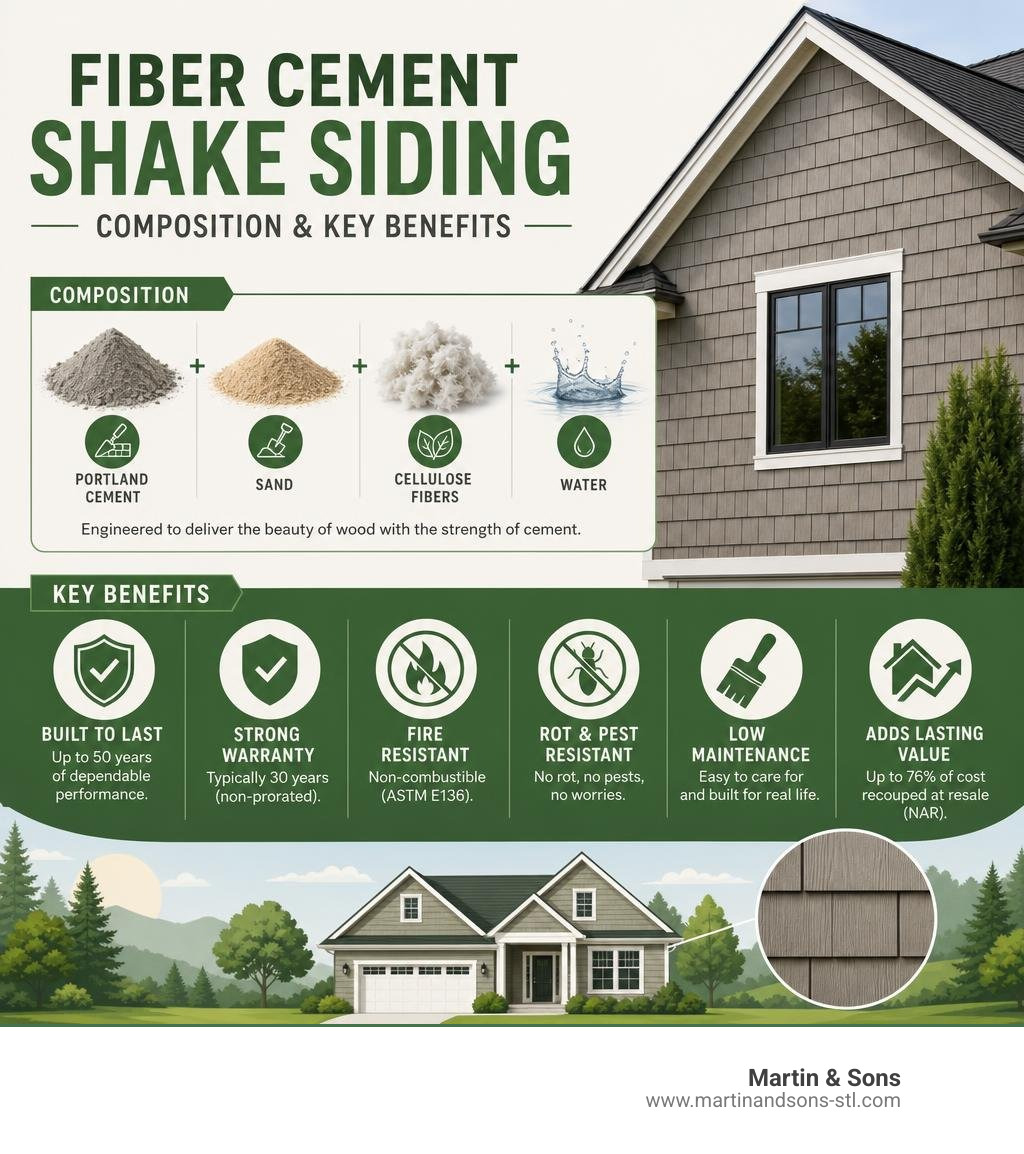
Here’s a quick snapshot of what you need to know:
| Feature | Cement Board Shake Siding |
|---|---|
| Material | Portland cement, sand, and cellulose fibers |
| Looks like | Traditional cedar shake |
| Lifespan | Up to 50 years |
| Warranty | Typically 30 years (non-prorated) |
| Fire resistance | Non-combustible (ASTM E136) |
| Maintenance | Low — no rot, no pest damage |
| Resale value | Up to 76% of cost recouped at resale (NAR) |
If you’re weighing your siding options after storm damage or just want a long-lasting upgrade, fiber cement shake is worth a serious look. It delivers the classic, textured curb appeal of wood shakes — but it’s tougher, safer, and far easier to live with over the long haul.
I’m John Martin, and along with my family, I’ve been installing and replacing siding in the St. Louis area for over 35 years — including cement board shake siding on everything from older bungalows to newer construction. In that time, I’ve seen how it holds up against Midwest weather, and I’ll walk you through everything you need to know to make a smart decision.
What is Cement Board Shake Siding?
To understand why this material has taken over the home exterior industry, we have to look at what it is made of. Cement board shake siding (often referred to interchangeably as fiber cement shake siding) is a composite material manufactured from a precise recipe: Portland cement, ground sand, cellulose (wood) fibers, and water.
During manufacturing, these ingredients are mixed, molded, and compressed under massive pressure to imprint a highly realistic wood grain texture. The result is a incredibly dense, heavy-duty plank or individual shingle that looks identical to hand-split cedar but behaves like rock.
Because it is mostly cement and sand, it does not rot, warp, or decay when exposed to moisture. The cellulose fibers act as a reinforcing agent, giving the siding the tensile strength it needs to resist cracking and handle physical impacts—such as stray baseballs or the occasional Missouri hail storm.
| Feature | Cement Board Shake | Traditional Wood Shake | Standard Vinyl Siding |
|---|---|---|---|
| Primary Material | Portland cement, sand, cellulose | Natural Cedar or Redwood | Polyvinyl Chloride (PVC) |
| Expected Lifespan | 50+ Years | 20–30 Years (with heavy maintenance) | 20–30 Years (prone to fading/cracking) |
| Fire Rating | Class A (Non-combustible) | Class C (unless heavily treated) | Class A (but melts quickly in high heat) |
| Pest & Rot Resistance | Impervious | Highly vulnerable to termites/rot | Impervious to rot, but can harbor pests behind |
| Maintenance Needs | Low (occasional wash & paint) | High (regular staining, sealing, washing) | Very Low (occasional wash) |
Comparing Wood Shakes vs. Cement Board Shake Siding
There is no denying the historic charm of genuine cedar shakes. They have graced coastal homes, rustic cabins, and Craftsman-style properties for centuries. However, real wood comes with a heavy tax on your time and wallet.
Natural wood is incredibly thirsty. If you do not paint, stain, or seal cedar shakes every few years, moisture will seep in. In our humid St. Louis summers, that trapped moisture leads directly to mold, mildew, and rot. Furthermore, wood is an open invitation for pests. Termites, carpenter ants, and woodpeckers love real wood siding.
When you switch to cement board shake siding, you completely eliminate these headaches. Woodpeckers can peck all day on fiber cement, and they will only end up with a headache. Termites cannot digest cement, and mold has no organic material to feed on.
While natural wood shakes eventually warp, cup, and split as they dry out under the hot sun, fiber cement remains completely dimensional stable. It holds its shape, keeping your home’s exterior looking crisp and uniform for decades. You can read a deeper breakdown of how different siding materials stack up in our comprehensive guide, Siding with the Best: A Guide to Exterior Pros and Cons.
The Benefits of Cement Board Shake Siding
When we talk to homeowners in Florissant, Chesterfield, and O’Fallon, their primary concerns are usually safety, durability, and how well their investment will hold up against the elements. Fiber cement shake siding checks every single box.

- Exceptional Fire Resistance: One of the most significant advantages of fiber cement is its fire rating. Unlike wood, which fuels a fire, and vinyl, which melts and releases toxic fumes, fiber cement is classified as a non-combustible material. It complies with ASTM E136 standards and carries a Class A fire rating. This means it will not ignite or act as an active fuel source if exposed to direct flames. This fire-resistant property is a major reason why many insurance companies offer premium discounts for homes clad in fiber cement.
- Superior Moisture and Pest Resistance: Because it contains no wood-based nutrients, fiber cement is completely immune to wood-boring insects and rot. It does not absorb water, preventing the freeze-thaw cracking that can destroy masonry and brick in cold climates.
- High Wind Load Performance: High-quality fiber cement systems are engineered to withstand severe wind loads. For example, technical evaluations like the ESR-3070 Evaluation Report show that engineered shake siding alternatives can withstand intense negative wind pressures, making them incredibly safe during severe Midwestern spring storms.
Long-Term Value and Warranty Coverage
Investing in new siding is a major financial decision. Fortunately, fiber cement is widely recognized as one of the smartest upgrades you can make to your home. According to the National Association of Realtors (NAR), fiber-cement siding ranks as the third-best exterior renovation project for recouping your costs, with homeowners recovering up to 76% of their initial investment at resale. It instantly boosts your home’s curb appeal, making it stand out in competitive local markets like St. Charles and Creve Coeur.
Beyond resale value, the long-term maintenance savings are substantial. When you calculate the lifetime costs of painting, repairing, and replacing cheaper materials, fiber cement easily wins the race. For a detailed comparison on how vinyl maintenance costs add up over time, check out our guide on Calculating the Lifetime Cost of Vinyl Siding Installation Repairs Maintenance.
Additionally, manufacturers back these products with some of the best warranties in the construction industry. Most major brands offer a 30-year non-prorated limited substrate warranty. To make sure you fully understand what is covered (and what isn’t), take a look at our article, Everything You Need to Know About Siding Warranties.
Design Options, Profiles, and Aesthetics
One of the best things about cement board shake siding is its incredible design versatility. Whether you want to cover your entire home for a coastal cottage look or simply use shakes as an accent in your gables, there is a profile to match your vision.
The most popular profiles include:
- Straight Edge Shakes: These offer clean, straight bottom lines that provide a refined, tailored look. They work beautifully on contemporary designs or modern farmhouse styles.
- Staggered Edge Shakes: With varying lengths and uneven bottom edges, staggered shakes create a more rustic, hand-crafted appearance. This profile is perfect for Craftsman homes and traditional styles.
- Wavy and Thatched Edges: These specialty profiles offer a highly textured, historic look, mimicking the hand-hewn shakes of early American architecture.
To achieve a truly premium look, manufacturers like Nichiha offer thick, deeply textured options. The Pre-finished Fiber Cement Shake Siding | Sierra Premium Shake | Nichiha USA features a 1/2-inch thick board profile. This extra thickness creates deeper, more dramatic shadow lines across your home’s exterior, giving it a visual weight and luxury feel that thinner siding products simply cannot match.
Furthermore, you can choose between primed-for-painting options or pre-finished siding. Pre-finished products utilize advanced factory-applied baked-on color technology. These finishes are applied in a controlled environment to all five sides of the board, ensuring maximum adhesion, UV resistance, and color consistency that lasts far longer than standard field-applied paint.
Installation and Climate Performance
Fiber cement is incredibly tough, but it is also heavy and rigid. This means proper installation is absolutely critical. Unlike wood, which can be easily nailed up by any handyman, fiber cement requires specialized tools and strict adherence to manufacturer specifications.
Manufacturers design products specifically for regional climates. For example, James Hardie uses the HardieZone system. Here in the St. Louis area (including our locations in St. Peters, Maryland Heights, and Florissant), we fall into the HZ5 zone. Products rated for HZ5 are engineered to resist extreme seasonal temperature swings, freezing snow, ice, and rapid freeze-thaw cycles.
Key installation requirements for our climate include:
- Approved Substrates: Siding must be installed over solid, code-compliant sheathing (like 7/16-inch OSB or 1/2-inch plywood) covered with a high-quality water-resistive barrier.
- Proper Fasteners: Installers must use hot-dipped galvanized or stainless steel ring shank siding nails to prevent rust streaking and ensure maximum holding power.
- Expansion Gaps and Clearances: Precise clearances must be maintained. For example, keeping a 1/4-inch gap at trim junctions and ensuring the siding sits at least 6 inches above the finished grade (soil) or 2 inches above hardscapes (like concrete patios and roofs) to prevent moisture absorption.
How to Maintain Your Cement Board Shake Siding
While fiber cement is low-maintenance, it is not “no-maintenance.” To keep your siding looking pristine and protect your warranty, follow these simple steps:
- Annual Inspections: Walk around your home once a year. Look for any signs of physical damage, loose boards, or failing caulk around windows, doors, and joints.
- Gentle Cleaning: Wash your siding once a year using a standard garden hose and a soft-bristle brush to remove dirt, pollen, and dust. Never use a high-pressure power washer, as the extreme pressure can damage the paint finish or force water behind the siding panels.
- Maintain Caulking: Over time, the caulk in the joints may shrink or crack. Re-caulk these areas using a high-quality, permanently flexible polyurethane or elastomeric sealant.
- Keep Gutters Clean: Ensure your gutters and downspouts are clear so water doesn’t overflow and constantly drench your siding.
If you are planning a complete exterior renovation, finding the right team is half the battle. Be sure to download The Ultimate Checklist for Hiring Siding Replacement Contractors to ensure your project is completed to the highest standards.
Frequently Asked Questions about Cement Board Siding
How long does cement board shake siding last?
When properly installed and maintained, high-quality fiber cement shake siding can easily last up to 50 years. Most major manufacturers back their substrates with a 30-year non-prorated warranty, giving you long-term peace of mind.
Can you paint fiber cement shake siding?
Yes! While many homeowners choose pre-finished options for their superior fade resistance and convenience, fiber cement can absolutely be painted. If you want to change your home’s color down the road, you can easily repaint it using high-quality 100% acrylic latex paint.
Is fiber cement shake siding fireproof?
While no building material is completely “fireproof” under extreme, prolonged volcanic-level heat, fiber cement is classified as non-combustible (complying with ASTM E136). It carries a Class A fire rating, meaning it will not ignite, spread flames, or act as an active fuel source during a house fire.
Conclusion
Upgrading to cement board shake siding is one of the best ways to protect your home, slash your weekend maintenance chores, and dramatically boost your curb appeal. It offers the timeless, rich texture of classic cedar shakes with the modern, rock-solid durability of fiber cement.
At Martin & Sons, we have been helping homeowners across the St. Louis metro area—from Chesterfield and Creve Coeur to St. Charles and O’Fallon—transform their homes for over 35 years. We believe in doing business the right way. That is why we offer no upfront deposits (you only pay when the job is 100% complete and you are fully satisfied), lifetime labor warranties, and our best prices upfront.
If you are ready to explore your siding options or want to see some fiber cement shake samples in person, we are here to help. Contact our team today to schedule your free, no-pressure consultation! To learn more about how different materials fit your budget and goals, read our guide, Siding with the Best: A Guide to Exterior Pros and Cons.