Why EPDM Rubber Roof Maintenance Is the Smartest Investment You Can Make
EPDM rubber roof maintenance is the routine care that keeps your flat or low-slope rubber roofing system watertight, energy-efficient, and built to last for decades. Here’s a quick overview of what it involves:
Core EPDM maintenance tasks at a glance:
- Inspect twice a year — spring and fall, plus after any major storm
- Clean 3-4 times per year — mild soap, soft brush, no petroleum or citrus cleaners
- Check seams and flashings — reseal any gaps immediately
- Clear drains and gutters — prevent ponding water from sitting more than 48 hours
- Patch small damage fast — punctures and tears worsen quickly if ignored
- Recoat every 10-15 years — silicone or acrylic coating extends lifespan significantly
EPDM is one of the most durable roofing materials available. With proper care, it can last anywhere from 25 to 50 years. But even tough materials need attention.
The problem is that most roof damage doesn’t announce itself. A small seam gap or a slow-draining drain can silently cause thousands of dollars in structural damage before you ever see a stain on your ceiling. Proactive maintenance is almost always cheaper than emergency repair.
This guide walks you through everything you need to know — from cleaning safely to knowing when to call a pro.
I’m John Martin of Martin & Sons, and with over 35 years of hands-on roofing experience in the St. Louis area, I’ve seen how a simple EPDM rubber roof maintenance routine can double a roof’s useful life. Let’s get into exactly what that routine looks like.

Quick look at epdm rubber roof maintenance:
What is EPDM and Why Proactive Care Matters
Ethylene Propylene Diene Monomer (EPDM) is a highly durable synthetic rubber roofing membrane widely used on flat and low-slope buildings throughout the St. Louis area. If you have ever touched a heavy-duty bicycle inner tube, you already know exactly what EPDM feels and looks like.
Chemically, EPDM is a thermoset membrane. This means the synthetic rubber molecules are permanently cross-linked during a process called vulcanization. Unlike thermoplastic membranes (such as TPO or PVC) which can be melted and re-welded with heat, EPDM’s chemical structure is locked in place. It does not rely on plasticizers that migrate out over time, which is why EPDM remains incredibly flexible even after decades of exposure to extreme temperatures.
To protect this polymer structure from the sun, manufacturers add carbon black during production. Carbon black acts as an outstanding UV and ozone stabilizer, absorbing damaging radiation and converting it into harmless heat. However, because carbon black makes the membrane naturally dark, EPDM roofs absorb a significant amount of heat. In the hot, humid summers of St. Louis, this can drive up cooling costs and accelerate thermal expansion unless the system is actively managed.
To understand how EPDM compares to other modern commercial membranes, you can read more in the EPDM Roofing Guide for Commercial Buildings in 2026.
Understanding EPDM Rubber Roof Maintenance
Many property owners treat flat roofing as a “set-it-and-forget-it” installation. This is a costly mistake. An EPDM roof should be treated as a major physical asset that requires active management rather than reactive, emergency repairs.
When you neglect routine epdm rubber roof maintenance, minor issues like a slightly separated seam or a clogged drain cover can quickly escalate. Because flat roofs lack the natural slope of pitched roofs, they collect significantly more organic debris, dust, and standing water. Over time, this debris acts like sandpaper under foot traffic, and standing water exerts constant hydrostatic pressure on your seams.
By shifting your approach from reactive patching to proactive preventative care, you can easily extend the lifespan of your EPDM membrane to its true potential of 25 to 50 years. Investing a small amount of time or money into annual maintenance prevents water from ever migrating under the membrane, protecting your underlying decking, insulation, and building interior. For a deeper look into why staying ahead of roof wear is so critical, check out our guide on Roofing Maintenance Service: Why Prevention Beats Cure.
The Ultimate EPDM Rubber Roof Maintenance Checklist
To keep your rubber roof in peak condition, you need a structured routine. Below is our comprehensive checklist that we recommend every property owner follow to ensure no critical details are overlooked:
- Clear All Loose Debris: Sweep or leaf-blow the entire roof surface to remove accumulated leaves, twigs, dirt, and organic matter.
- Inspect the Membrane Surface: Walk the roof slowly, looking for punctures, tears, cuts, or unusual wear patterns.
- Examine All Seams and Joints: Check the edges where EPDM sheets overlap. Look for any signs of peeling, lifting, or “fish-mouthing.”
- Check Roof Penetrations and Flashings: Inspect the seals around HVAC units, pipes, vents, chimneys, skylights, and termination bars.
- Test and Clear the Drainage System: Inspect all roof drains, scuppers, and gutters for blockages. Ensure water flows freely off the roof.
- Evaluate Parapet Walls and Edge Details: Check vertical transitions and parapets to ensure the membrane is securely fastened and has not pulled away.
For a detailed breakdown of how to structure these tasks on a commercial scale, read our article on 5 Best Practices for Commercial Roofing Maintenance.
Inspection Frequency and Seasonal Timing
We strongly recommend conducting detailed roof inspections at least twice a year—once in the spring and once in the fall.
- Spring Inspections: The goal of a spring walkthrough is to identify and repair any damage caused by winter freeze-thaw cycles, heavy snow loads, or ice dams.
- Fall Inspections: Fall inspections are critical for clearing out fallen leaves and preparing the drainage system for winter. Finding and sealing minor seam gaps before freezing temperatures arrive prevents water from getting trapped, freezing, expanding, and tearing the membrane apart.
In addition to seasonal inspections, you should perform a quick visual check after any severe weather event, such as high-wind storms, heavy hail, or torrential summer rains. St. Louis weather is notoriously volatile, and a single windstorm can toss tree branches onto your flat roof, creating hidden punctures. For more technical insights on how seasonal weather transitions impact single-ply membranes, consult the EPDM Roofing Association’s guide on maximizing roof performance.
Safe Cleaning Methods and Chemical Warnings
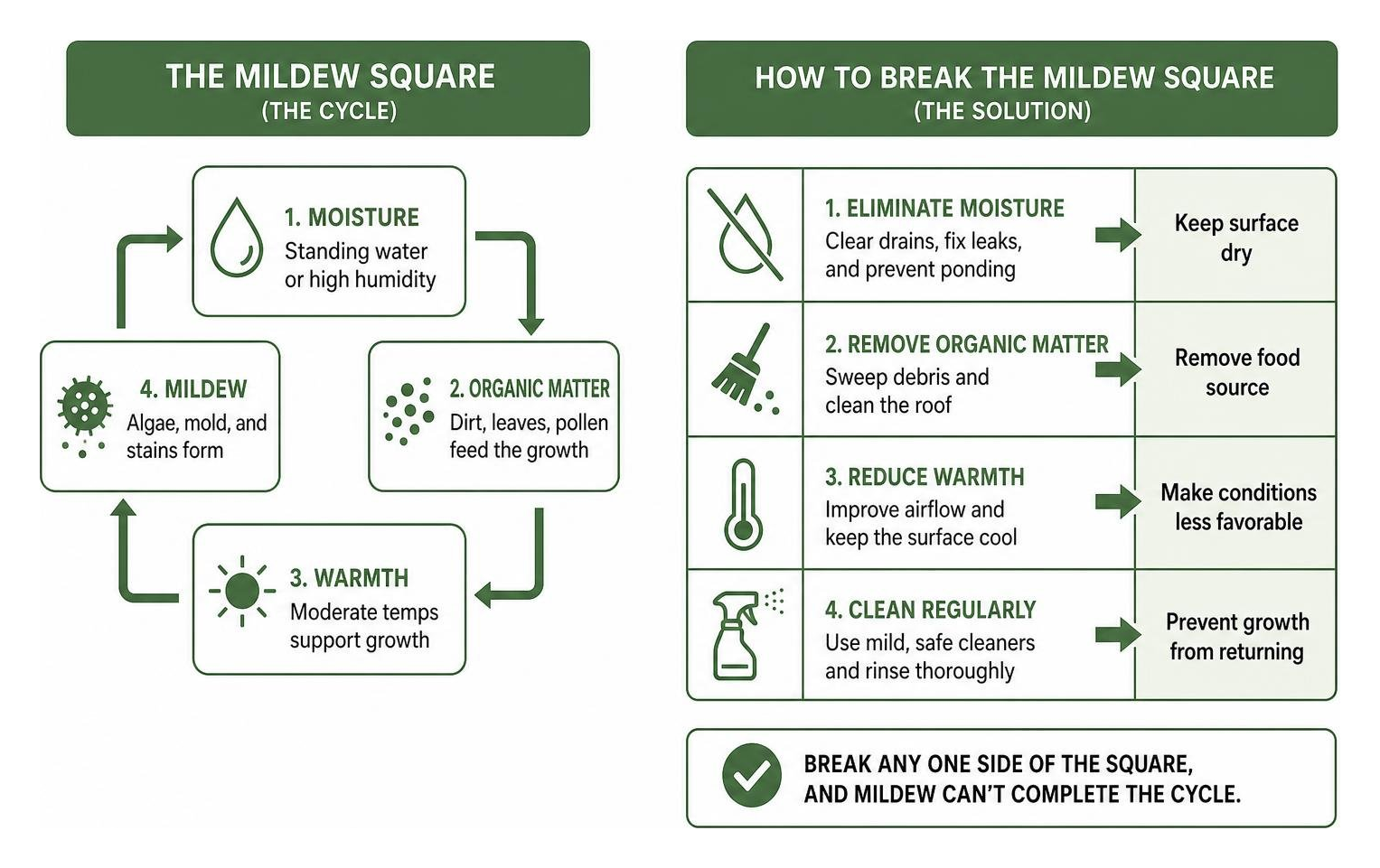
Keeping your EPDM roof clean is about more than just aesthetics. Mold, mildew, and algae do not grow on the rubber itself, but they thrive on the layer of atmospheric dust, pollen, and moisture that settles on flat roofs. Because white or light-colored EPDM roofs reflect heat, they rarely reach the 126°F surface temperature required to naturally kill off these microorganisms.
We recommend cleaning your EPDM roof at least four times per year if your property is surrounded by trees or exposed to heavy environmental fallout.
To clean the roof safely:
- Rinse the surface with clean water to wash away loose dirt.
- Mix a mild, non-abrasive cleaner (like standard Dawn dish soap or Tri-Sodium Phosphate) in a large bucket of warm water.
- Scrub the membrane gently using a medium-to-soft bristle brush. Never use a stiff wire brush, as this can easily puncture the rubber.
- Rinse the entire roof thoroughly with a garden hose, ensuring you wash down the building’s siding and windows to prevent dirty chemical runoff from staining your exterior.
CRITICAL WARNING: You must avoid any cleaning products containing petroleum solvents, harsh abrasives, or citric-based ingredients. EPDM is highly sensitive to hydrocarbons. Petroleum distillates chemically react with synthetic rubber, causing the membrane to swell, warp, lose its structural integrity, and ultimately dissolve. Even seemingly harmless “natural” citrus cleaners contain oils that can break down EPDM’s molecular bonds. Using unapproved chemicals will permanently damage your roof and instantly void your manufacturer’s warranty. For safe cleaning guidelines, you can review the EPDM Maintenance & Care documentation.
Managing Drainage and Ponding Water
Flat roofs are naturally susceptible to ponding water, which is defined as standing water that remains on the roof surface for more than 48 hours after a rainfall. Standing water is the enemy of any low-slope roofing system. It places continuous hydrostatic pressure on your seams, accelerates the degradation of adhesives, and encourages rapid algae and mold growth. Furthermore, the weight of ponding water can cause the roof deck to sag over time, creating an even deeper depression that collects more water.
To prevent ponding:
- Keep Drains and Scuppers Clear: Regularly clear leaves and debris from your roof drains. A simple, inexpensive plastic drain cover clogged with autumn leaves can easily hold back thousands of gallons of water, creating an accidental swimming pool on your roof.
- Perform Flow Tests: During your bi-annual inspections, pour a bucket of water near your drains to ensure it exits the building quickly and completely.
- Consider Tapered Insulation: If you have persistent low spots where water ponds for days, the ultimate solution is to install tapered polyisocyanurate insulation. This creates a slight slope that directs water toward your drainage points.
- Roof-and-Gutter Integration: While we are a full-service roofing company, we only install or service gutters in conjunction with a complete roofing project. Ensuring your gutters and roof drainage systems are perfectly aligned is critical to preventing water from backing up under your EPDM edges.
Identifying and Repairing Common EPDM Issues
Identifying issues early is the key to cost-effective roof management. When inspecting your EPDM roof, pay close attention to signs of physical wear, punctures from fallen branches, and structural movement. If you suspect your flat roof has a leak but can’t find the source, read our guide on Flat Roof Repair in St. Louis, MO: Keeping Your Modern Home Water-Tight.
Fixing Punctures, Tears, and Blisters
Despite its incredible flexibility, unreinforced EPDM is vulnerable to sharp objects. A dropped tool by an HVAC technician, a windblown tree branch, or even a nesting bird can puncture the membrane.
Blisters are another common issue. These occur when moisture becomes trapped between the EPDM membrane and the roof deck or insulation during installation. When the hot St. Louis sun beats down on the dark rubber, this trapped moisture vaporizes and expands, creating a raised bubble or blister.
How to repair minor punctures and tears:
- Clean the Area: Scrub the rubber around the damage with an approved cleaner and let it dry completely.
- Apply Primer: Apply a thin, even coat of EPDM-compatible primer to the clean surface. This step is critical; standard adhesives will not stick to weathered EPDM without a primer.
- Cut the Patch: Cut a piece of self-adhering EPDM patch material, ensuring it extends at least 2 inches beyond the damage in all directions. Round the corners of the patch to prevent them from catching and peeling up later.
- Apply and Roll: Press the patch firmly onto the primed area. Use a heavy hand roller to roll the patch from the center outward, ensuring all air bubbles are squeezed out and a tight bond is formed.
For a step-by-step overview of flat roof repairs, see our article Everything You Need to Know About Fixing Flat Roofs.
Addressing Seam Separation and Flashing Failures
An incredible 90% of all flat roof leaks originate at the seams and flashings, not through the center of the membrane sheet. Over time, the adhesives and tapes used to bond adjacent EPDM sheets can degrade due to constant exposure to UV rays, thermal expansion, and standing water. This leads to seam separation, often called “fish-mouthing,” where the edges of the rubber roll upward.
To repair a failing seam:
- Clean the Seam: Gently clean the old adhesive area using a cloth dampened with mineral spirits. Allow the solvent to evaporate completely (usually about 15 minutes).
- Apply New Sealant or Tape: For long-term reliability, we recommend applying heavy-duty seam tape (such as Eternabond) or a high-performance, self-leveling lap sealant directly over the prepped seam.
- Roll the Seam: Use a silicone hand roller to ensure complete adhesion.
- Seal the Edges: Apply a bead of EPDM lap sealant along the exposed edges of the patch or tape to prevent water from driving underneath.
Extending Lifespan: Recoating vs. Replacement
As your EPDM roof approaches the 15-to-20-year mark, you will face a critical decision: should you restore the roof with a protective liquid coating, or is it time for a complete replacement?
Restoring a structurally sound EPDM roof with a high-quality liquid rubber coating is incredibly cost-effective, typically costing about 50% less than a full tear-off and replacement. It also avoids building disruption and keeps tons of old roofing material out of local landfills.
| Feature | EPDM Liquid Recoating | Full Roof Replacement |
|---|---|---|
| Average Cost | ~50% less than replacement | Full capital expenditure |
| Lifespan Added | 10 to 20 years | 25 to 50 years |
| Disruption Level | Low (liquid application) | High (tear-off & structural work) |
| Energy Efficiency | High (reflects 85-90% of UV) | Depends on membrane color chosen |
| Substrate Requirement | Must have dry, intact insulation | Replaces damaged/wet insulation |
When to Recoat and Choosing the Right Coating
Generally, an EPDM roof should be recoated every 10 to 15 years, or when you notice widespread “alligatoring” (fine, shallow cracks on the surface), excessive chalking, or minor brittleness.
When choosing a coating, you have two primary options: silicone and acrylic.
- Silicone Coatings: Silicone is vastly superior for flat roofs in the St. Louis climate. It is a highly durable, solvent-based material that does not re-emulsify or soften when exposed to long-term ponding water. It also offers incredible flexibility, allowing it to stretch and contract during extreme temperature swings without cracking.
- Acrylic Coatings: While cheaper, acrylic coatings are water-based. If water ponds on an acrylic-coated roof for more than a few days, the coating can turn back into a liquid state and peel away from the rubber.
By applying a highly reflective white silicone coating, you create a “cool roof” effect. These coatings reflect 85% to 90% of solar radiation, dropping roof surface temperatures by up to 70°F on a hot July afternoon. This significantly reduces the strain on your HVAC systems and lowers your building’s cooling costs. For more details on upgrading your roof’s chemistry with liquid coatings, read the EPDM Coatings Blog’s tips on keeping your roof in shape.
Signs Your EPDM Roof Needs Replacement
While coatings are excellent, they cannot save a roof that is fundamentally failing. You should opt for a full replacement if you observe any of the following critical issues:
- Severe Membrane Shrinkage: EPDM naturally shrinks slightly over time due to thermal cycling. If the original installer omitted mechanically fastened securement strips (known as RUSS details) at the vertical transitions, this shrinkage tension will pull the membrane away from parapet walls. This causes “bridging,” where the rubber stretches tight like a drum head, eventually tearing at the corners.
- Saturated Insulation: If leaks have gone unnoticed for years, water may have saturated the underlying polyiso insulation boards. Coating over wet insulation traps moisture inside the roof assembly, which destroys your R-value, rots your wood decking, and corrodes metal fasteners.
- Extensive Physical Damage: If more than 25% of the roof surface has active tears, punctures, or failed seams, patching becomes a temporary and costly distraction from the inevitable.
Before making a decision, we recommend conducting an infrared thermographic moisture scan. This advanced technology maps temperature differences across your roof surface at night, allowing us to pinpoint exactly where wet insulation is trapped beneath an otherwise perfect-looking membrane.
DIY vs. Professional EPDM Care
While homeowners and building maintenance staff can easily handle basic tasks like sweeping off leaves or patching a single tiny puncture with a DIY kit, complex repairs should always be left to professionals.
EPDM requires specialized primers, splice adhesives, and precise flashing techniques to remain watertight. Rushing a seam repair on a hot summer day without allowing the primer to flash off properly, or using incompatible hardware store sealants, will cause the repair to fail within months. Furthermore, professional maintenance documentation is often required to keep your manufacturer’s material warranty valid.
Our local St. Louis climate presents unique challenges. From freezing winter ice storms in O’Fallon and St. Charles to humid, high-heat summers in Florissant and Chesterfield, your EPDM roof experiences massive thermal expansion and contraction. At Martin & Sons, we understand these local climate patterns and design our maintenance programs to withstand them.
Safety Considerations for EPDM Rubber Roof Maintenance
Working on a flat roof comes with significant safety risks that must never be ignored.
- Extremely Slippery Surfaces: Wet EPDM is incredibly slick—almost like walking on ice. Never step onto a wet rubber roof without specialized, slip-resistant footwear.
- Fall Protection: Flat roofs often lack perimeter railings. Always utilize a safety harness and personal fall arrest systems when working within 6 feet of a roof edge, and never work alone.
- Protect the Membrane: Walkway pads should be installed in high-traffic zones, such as around roof hatches and HVAC units. Heavy work boots or dropped tools from technicians can easily puncture the rubber. If you must walk on the roof, wear soft-soled shoes and distribute your weight carefully.
Frequently Asked Questions about EPDM Care
Can I pressure wash my EPDM roof?
Yes, but you must exercise extreme caution. Keep the pressure washer settings under 1,500 PSI and use a wide fan spray tip. Keep the wand at least 12 to 18 inches away from the membrane surface, and never spray directly at seams, lap joints, or flashings. High-pressure water can easily tear open aged seams or drive water underneath the membrane.
Why is my rubber roof turning white and chalking?
Chalking is a natural aging process of EPDM. Over years of exposure to sunlight and heat, the carbon black and white titanium dioxide fillers used during manufacturing slowly oxidize and migrate to the surface, creating a fine, powdery residue. When it rains, this chalky residue runs down the sides of your building, creating unsightly white streaks on your siding and windows. Regular cleaning and applying a protective silicone coating will stop this process completely.
How long does a rubber roof last with proper care?
With a proactive epdm rubber roof maintenance program, a high-quality EPDM roof can easily last 25 to 50 years. Without maintenance, a flat roof can fail in as little as 10 to 15 years due to seam separation, clogged drains, and trapped moisture.
Conclusion
Your roof is your building’s first line of defense against the elements. Taking care of your EPDM system through routine cleaning, bi-annual inspections, and timely repairs is the single most effective way to protect your investment and avoid the massive capital expense of a premature roof replacement.
At Martin & Sons, we make professional roof care completely stress-free. We proudly serve residential and commercial property owners throughout the St. Louis area, including Florissant, St. Charles, St. Peters, Chesterfield, Creve Coeur, Maryland Heights, and O’Fallon.
Why choose Martin & Sons?
- No Upfront Deposits: You don’t pay a single penny until the job is 100% complete and you are entirely satisfied.
- Lifetime Labor Warranties: We stand behind the quality of our craftsmanship for the lifetime of your roof.
- Best Prices Upfront: No sales gimmicks, no hidden fees—just honest, transparent pricing from day one.
Don’t wait for a minor seam gap to turn into a major structural headache. Schedule your professional EPDM maintenance with Martin & Sons today, or call us at our Florissant office at 8460 N. Lindbergh Blvd. Suite 11 to speak with one of our flat roofing specialists.