
What Does the cost to install window screens Actually Look Like?
Here’s a quick answer before we dive in:
| Project Type | Typical Cost Range |
|---|---|
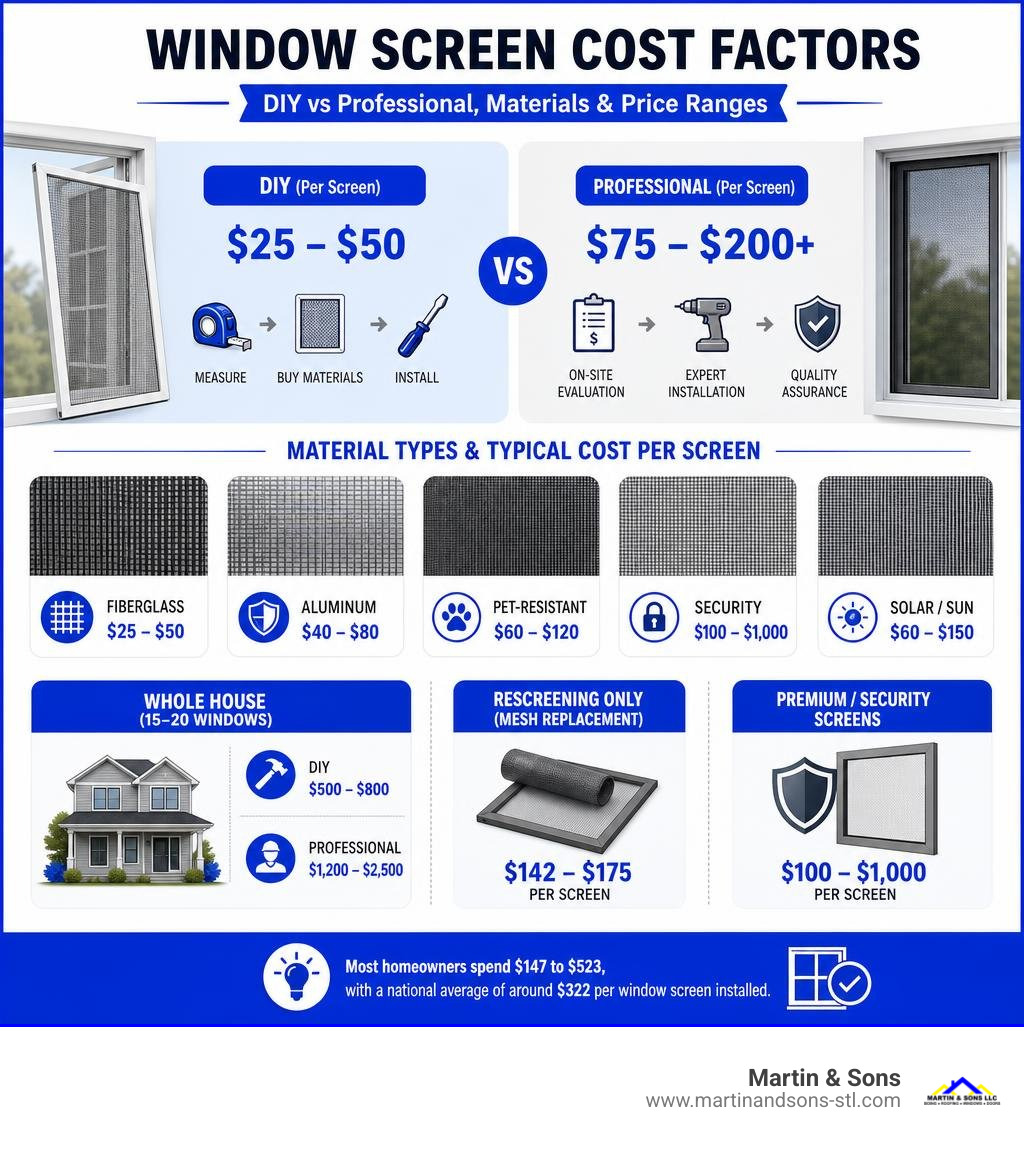
| DIY (per screen) | $25 – $50 |
| Professional (per screen) | $75 – $200+ |
| Whole house, DIY (15–20 windows) | $500 – $800 |
| Whole house, professional (15–20 windows) | $1,200 – $2,500 |
| Rescreening only (mesh replacement) | $142 – $175 per screen |
| Premium/security screens | $100 – $1,000 per screen |
Most homeowners spend $147 to $523, with a national average of around $322 per window screen installed.
The price swings based on a few key things: screen material, window size, how hard the windows are to reach, and whether you hire a pro or do it yourself.
Window screens are one of those things you don’t think about until they’re torn, sagging, or letting bugs in. Then suddenly it’s urgent — and you want to know exactly what it’s going to cost before anyone shows up at your door.
This guide breaks it all down simply and honestly, so you can budget with confidence and avoid overpaying.
I’m John Martin, owner of Martin & Sons — a family-run business serving St. Louis since 1953 with over 35 years of personal experience in home improvement, including helping homeowners understand the real cost to install window screens and make smart decisions about materials and installation. We’ll walk you through everything you need to know before spending a dollar.
Related content about cost to install window screens:
Understanding the Cost to Install Window Screens

When you look at the total bill to get new screens, it is easy to wonder where those numbers actually come from. The average window screen replacement cost ranges from $105 to $482 per screen, with an overall average of about $310 to $322.
If you are looking at What Does It Cost to Replace Window Screens?, you will find that the final price tag is split into two primary buckets: the materials (the screen mesh, frame, spline, and hardware) and the labor required to put it all together and fit it to your home.
Here in the St. Louis area — from the historic streets of Florissant to the newer neighborhoods in St. Peters and O’Fallon — our hot, humid summers and freezing winters mean window screens take a beating. If you are hunting for local options, checking out Screening Your Options for Quick Window Screen Replacement Nearby can help you find fast, dependable service.
To give you a clearer picture of how these project scopes compare, let’s look at a realistic breakdown of typical screen projects:
| Project Scope | Material Cost | Labor Cost | Total Estimated Cost |
|---|---|---|---|
| Single Screen (Standard Fiberglass) | $15 – $30 | $30 – $80 | $75 – $110 |
| Single Screen (Solar / Pet-Proof) | $40 – $100 | $40 – $90 | $150 – $250 |
| Single Screen (Security Grade) | $120 – $520 | $100 – $600 | $360 – $1,200 |
| Whole House (15–20 Windows, Standard) | $300 – $600 | $900 – $1,900 | $1,200 – $2,500 |
DIY vs. Professional Cost to Install Window Screens
Taking on a window screen installation as a DIY project is highly appealing if you want to keep costs to an absolute minimum. A basic DIY screen replacement typically runs between $25 and $50 per screen in total materials. You will need to buy the mesh roll, the rubber spline, a spline roller tool, and a sharp utility knife.
However, professional window screen installation averages $75 to $200+ per window screen once you factor in labor. Professional labor rates for installing screens generally run between $30 and $80 per screen for standard windows.
Why the price jump? Aside from the physical labor, many professional screen companies charge a minimum service fee of $100 to $200 just to cover travel, fuel, and mobilization. If you are only replacing one or two screens, hiring a pro can feel expensive. But if you have a larger project, professionals often waive or absorb that minimum fee into a competitive package rate.
Furthermore, let’s not forget the “frustration tax.” Getting a screen perfectly drum-tight without warping the aluminum frame takes a surprising amount of practice. If you pull the mesh too tight, the frame will bow inward like an hourglass. If you leave it too loose, it will sag and rattle in the wind. When you hire a professional, they absorb the cost of any measurement or installation mistakes.
Whole-House Cost to Install Window Screens
If your home’s screens are reaching the end of their 10-to-12-year lifespan, replacing them all at once is almost always the smartest financial move.
For a typical home with 15 to 20 windows:
- DIY Whole-House Cost: $500 to $800 (mostly material costs and your own weekend labor).
- Professional Whole-House Cost: $1,200 to $2,500 (fully installed, tensioned, and warrantied).
When you bundle multiple windows into a single project, contractors can offer significant volume pricing discounts. It takes almost the same amount of travel and setup time for a crew to replace 3 screens as it does to replace 15, so your per-screen labor rate drops dramatically when you complete the whole house.
If you are planning a larger renovation, you might also be weighing screen costs against a full window upgrade. To see how these smaller projects fit into the bigger picture of home improvement, take a look at The Ultimate Guide to Window Replacement Cost.
Cost Breakdown by Screen Material and Type
The material you choose for your mesh has a massive impact on both the durability of your screens and your final invoice. Let’s look at the most common materials available on the market today:
- Fiberglass: This is the industry standard. It is incredibly common, flexible, rust-resistant, and budget-friendly. Standard fiberglass screens cost $60 to $260 per window installed. On average, the raw mesh costs about $0.50 per square foot.
- Aluminum: Stronger and more durable than fiberglass, aluminum screens resist tears and punctures from falling branches or persistent squirrels. However, they can dent if bumped hard. Aluminum screens cost $80 to $390 per window installed (averaging $0.65 per square foot for the material).
- Vinyl: Extremely flexible and highly resistant to coastal salt air or heavy Midwest humidity, vinyl-coated screens run $25 to $120 for the materials.
- Stainless Steel & Copper: These are premium specialty metals. Stainless steel is incredibly tough and often used in security applications, costing $80 to $460 per window. Copper and brass offer a gorgeous, historic look that weathers to a beautiful dark bronze patina over time, but they are highly premium, ranging from $120 to $980 per window depending on the size.
If you are looking for specialized heat and UV protection, you can explore the Window Sun Screens Cost to see how different frame and mesh combinations stack up.
Standard Insect Screens vs. Premium Upgrades
While basic fiberglass mesh is great for keeping Missouri mosquitoes out, many homeowners choose to upgrade to specialty fabrics designed for specific household needs:
- Pet-Proof Screens: Made from heavy-duty vinyl-coated polyester, pet screens are roughly seven times stronger than standard fiberglass. They easily withstand clawing and scratching from dogs and cats. Upgrading to pet-proof screens costs $150 to $560 per window installed (adding about $15 to $30 per screen over standard prices).
- Security Screens: If you want to keep your windows open for fresh air without sacrificing home security, these screens feature heavy-duty steel mesh and reinforced frames with multi-point locking systems. They are designed to withstand blunt force and knives. According to the Window Security Screen Cost Guide, these high-end installations typically cost $100 to $1,000+ per window.
- Solar Screens: Designed specifically to block heat and damaging UV rays before they reach your glass, solar screens act as an energy-efficient upgrade. This is especially true for south- and west-facing windows in sunny areas like Chesterfield or St. Charles. These screens can add $40 to $70 per screen in material costs. You can learn more about these specialized systems in the Exterior Solar Window Screen Cost Guide 2026.
Key Factors and Savings Strategies for Window Screens
Beyond the material of the mesh itself, several physical and environmental variables will drive the final price of your project up or down:
- Window Size and Shape: Standard off-the-shelf screens fit window openings ranging from 18″ x 20″ up to 36″ x 74″. If you have standard double-hung or sliding windows, preassembled screens are highly affordable. However, if you have large picture windows, custom architectural shapes (like arched or round-top windows), or custom grids, expect material and labor costs to increase by 50% to 100%.
- Accessibility and Height: Ground-floor installations are quick and simple. However, second-story or third-story windows require ladders, hoisting equipment, and extra safety precautions. Working on elevated windows typically adds $10 to $25+ per screen to the labor cost.
- Frame Material and Color: Standard aluminum frames in white, bronze, or mill finish are the most affordable. If you have custom wood frames or rigid polycarbonate frames, expect to pay a premium.
If your screens are failing, it might also be a sign of wider window issues. To evaluate whether you need a quick screen swap or a larger window project, read about the Signs That It Is Time to Consider a New Window Installation.
To keep your hard-earned money in your pocket, use these smart saving strategies:
- Consolidate and Bundle: Never hire a pro to replace just one screen. Group all your damaged screens together into a single project to bypass multiple minimum service fees and secure volume discounts.
- Mix and Match Materials: You do not need premium pet screens on your second story. Use heavy-duty pet mesh on your patio doors and lower-level windows, solar screens on sun-drenched west-facing windows, and standard fiberglass on the rest of the house.
- Reuse Existing Frames: If your metal frames are straight, sturdy, and free of cracks, do not buy new ones! You can save a massive amount of money by simply rescreening.
- Schedule Off-Peak: Contractor demand peaks in the spring and early summer. Booking your screen installation in the late fall or winter can help you secure better rates and faster scheduling.
Rescreening vs. Full Screen Replacement
One of the most common questions we get is: “Do I need a whole new screen unit, or can you just replace the mesh?”
The answer depends entirely on the condition of your existing frames.
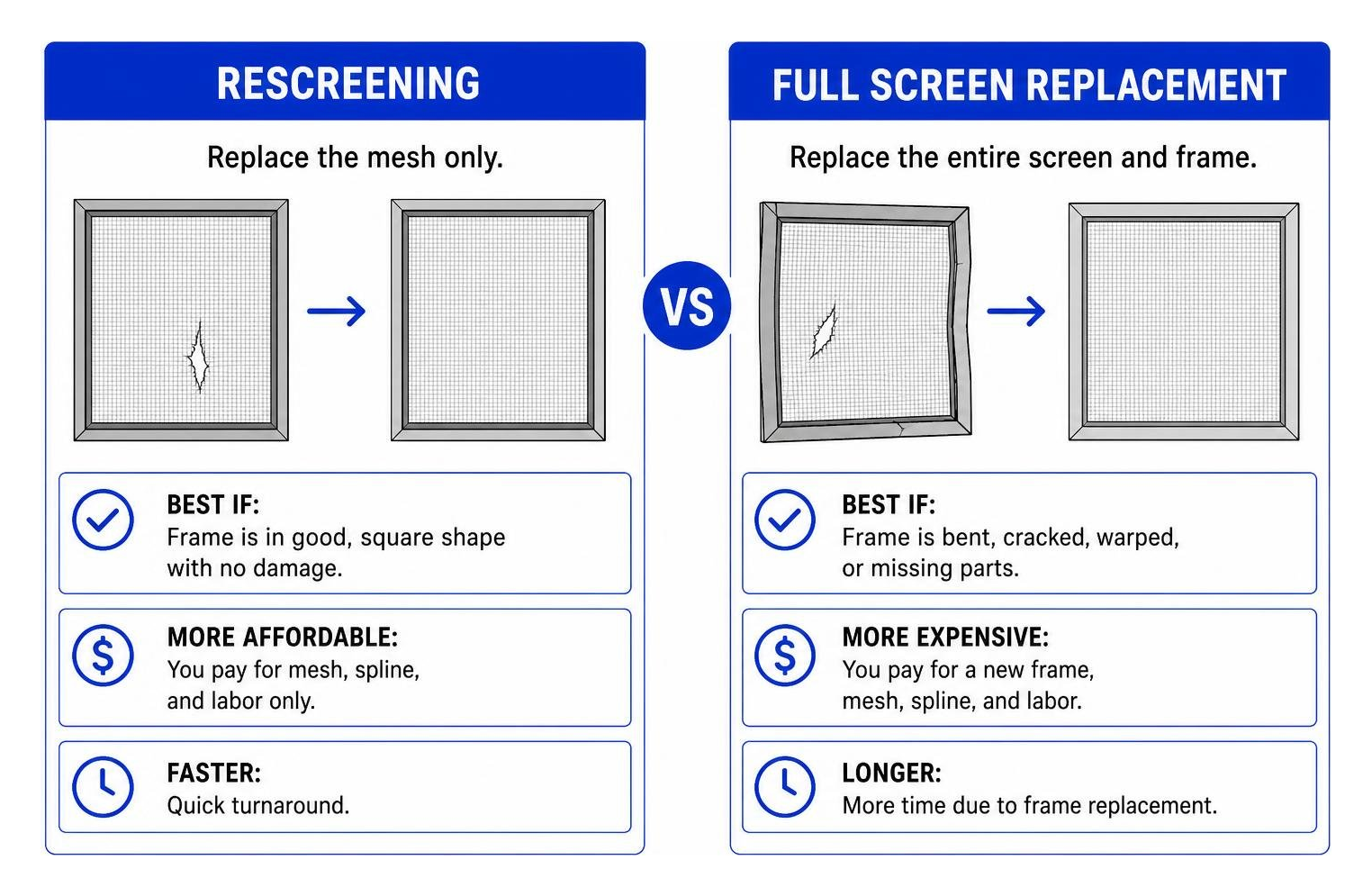
If your aluminum frames are bent, cracked, warped, or missing their corner tension springs, a full replacement is necessary. Trying to force a new mesh into a warped frame is a recipe for frustration, and the screen will likely pop out of the window frame during the next heavy windstorm.
However, if your frames are still in excellent, square shape, rescreening is significantly cheaper. In fact, rescreening is often the most cost-effective route because you are only paying for a roll of mesh, some cheap rubber spline, and a bit of labor.
Frequently Asked Questions About Window Screens
How long do window screens typically last?
Most standard fiberglass and aluminum window screens last between 10 and 12 years. Over time, constant exposure to the sun’s UV rays, rain, and temperature swings will make fiberglass mesh brittle. You will know your screens are ready for retirement when the mesh starts to fray, sag, crumble to the touch, or develop tiny holes that let pests inside.
Are window screens standard sizes?
Yes and no. Most residential homes built in the last few decades use standard window dimensions, meaning off-the-shelf, preassembled screens will fit perfectly. These typical sizes range from 18″ x 20″ up to 36″ x 74″. However, custom-built homes, older historic properties, or architectural windows with unique shapes will require custom-fabricated screens built to the exact millimeter.
Is it cheaper to rescreen or replace the entire unit?
It is substantially cheaper to rescreen if your existing frames are still straight and sturdy. Rescreening only requires new mesh and spline, saving you from paying for brand-new aluminum frames. However, if your frames are bent, warped, or corroded, a full replacement is the only way to ensure a tight, bug-free fit.
Conclusion
Getting new window screens does not have to be a headache. Whether you choose to spend a weekend tackling a DIY rescreening project or decide to bring in a professional to handle a whole-house upgrade, understanding the real cost to install window screens keeps you in control of your budget.
If you are planning to upgrade your home’s exterior, it is also highly beneficial to understand the broader market. You can read up on the Top 8 Factors That Affect Replacement Window Prices to make sure you are getting the absolute best value.
At Martin & Sons, we believe in making home improvements completely stress-free for our neighbors across the Greater St. Louis area. We do things a little differently than the other guys: we require no upfront deposits, meaning you only pay when the job is 100% complete and you are entirely satisfied. Plus, we back our craftsmanship with robust lifetime labor warranties and give you our best, most honest prices right upfront.
Ready to enjoy fresh breezes without the bugs? Give us a call or visit our showroom at 8460 N. Lindbergh Blvd. Suite 11 in Florissant, MO to chat about your next project!