
What Does It Really Cost to Replace 17 Windows?
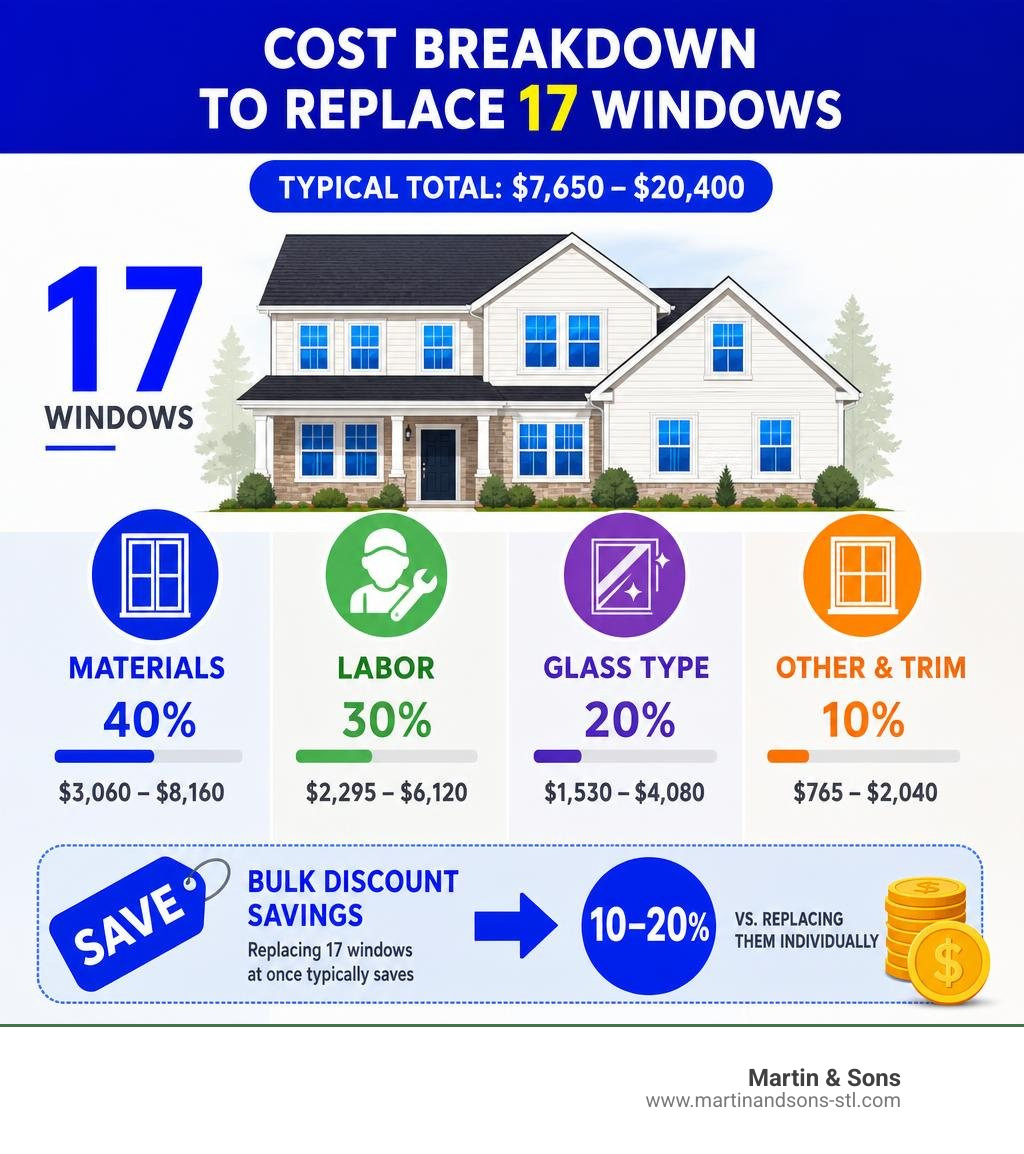
The cost to replace 17 windows in a typical home runs between $7,650 and $20,400 in 2026 — and often lands around $12,750 at the national average of $750 per window installed.
Here’s a quick snapshot so you can plan your budget right now:
| Project Size | Low Estimate | Mid Estimate | High Estimate |
|---|---|---|---|
| 5 windows | $2,250 | $3,750 | $6,000 |
| 10 windows | $4,500 | $7,500 | $12,000 |
| 17 windows | $7,650 | $12,750 | $20,400 |
| 25 windows | $11,250 | $18,750 | $30,000 |
Estimates based on $450–$1,200 per window installed, including labor and materials. Replacing 17 windows at once typically saves 10–20% vs. replacing them individually.
These numbers can feel like a gut punch at first. But a lot of that sticker shock fades once you understand what’s actually driving the price — and where you can save.
Windows are not all created equal. Frame material, glass type, installation method, and your home’s layout all push costs up or down significantly. A basic vinyl double-hung insert replacement sits at the low end. A wood full-frame replacement on a two-story home sits at the high end. Most homeowners land somewhere in the middle.
There’s also real money on the other side of this investment. Over 66% of homeowners report saving $25–$100 per month on utility bills after replacing old windows. Heat lost or gained through windows accounts for 25–30% of a home’s total heating and cooling costs — so 17 new, energy-efficient windows can make a meaningful dent in your energy bills year after year.
I’m John Martin of Martin & Sons, and with over 35 years of hands-on experience in window replacement, I’ve helped hundreds of St. Louis homeowners understand the true cost to replace 17 windows — no surprises, no pressure. Let’s walk through exactly what goes into these numbers.
Basic cost to replace 17 windows glossary:
What is the Average Cost to Replace 17 Windows?
When we look at a whole-house project of this size, we are moving past single-unit averages and looking at project-scale pricing. In 2026, the national average cost to install replacement windows starts at $632 to $967 per window, which includes both labor and materials. For a single window, the average cost sits around $477, with a typical range of $232 to $740 depending on the quality and complexity of the install.
However, when you scale up to 17 windows, your project enters a sweet spot. Most window manufacturers and local contractors offer volume discounts because we can streamline our labor, order materials in bulk, and complete the work in a single continuous trip. Instead of paying the maximum retail price per window, homeowners can expect to save 10% to 20% overall compared to replacing windows one by one.
To help you visualize how a 17-window project scales against other project sizes, we have broken down the average cost expectations below:
| Number of Windows | Average Cost Range (Installed) | Typical Project Scope |
|---|---|---|
| 1 Window | $232 – $740 | Single broken unit or small repair |
| 5 Windows | $2,385 – $4,835 | Partial replacement (one side of house or single room) |
| 10 Windows | $6,500 – $12,000 | Small home or townhome whole-house replacement |
| 17 Windows | $7,650 – $20,400 | Average-sized St. Louis home whole-house project |
| 25 Windows | $11,925 – $30,000+ | Large two-story home or custom architectural project |
To get a better foundation on how these baseline numbers are established, you can read our Beginner’s Guide to Window Replacement Cost. For an interactive look at how your specific zip code and preferences change these numbers, you can also check out the Window Replacement Cost Calculator — Per Window & Whole House (2026) | ConstructlyTools.
Generally, labor accounts for roughly 40% to 50% of these total figures, running between $100 and $300 per window. The remaining 50% to 60% goes toward the window materials, custom sizing, and job supplies.
Breaking Down the Cost to Replace 17 Windows by Material
The material you choose for your window frames is the single largest variable under your control. Let’s look at how the total cost for 17 windows scales across the most common frame materials in 2026:
- Vinyl Frames ($6,800 – $15,300 total): Vinyl is the most popular choice for whole-house projects because of its incredible balance of price, low maintenance, and energy efficiency. Standard vinyl double-hung insert replacements run about $400 to $900 per window installed. For a complete guide on what to expect, read The Complete Guide to Vinyl Windows.
- Fiberglass Frames ($8,500 – $25,500 total): Fiberglass is roughly 8 times stronger than vinyl and expands and contracts very little in extreme temperatures. It carries a 20% to 40% price premium, costing $500 to $1,500 per window installed, but it is highly recommended for cold climates and oversized glass.
- Wood Frames ($14,875 – $31,700 total): Wood is the premium, classic choice. It is highly sought after in historic districts but requires regular painting and sealing to prevent rot. Wood windows average $875 to $1,865 per window installed. If you love the look of wood but hate the maintenance, you might want to read about The Best of Both Worlds: A Guide to Vinyl Clad Wood Windows.
- Composite Frames ($9,000 – $22,000 total): Made from a blend of wood fibers and plastic polymers, composite frames offer the strength of wood with the low-maintenance qualities of vinyl. They typically run $529 to $1,300 per window installed.
- Aluminum Frames ($7,600 – $14,000 total): While aluminum is strong and affordable (averaging $448 per window), it conducts heat 1,000 times faster than vinyl. Unless they feature a specialized thermal break, aluminum frames are rarely recommended for Missouri’s freezing winters and hot summers.
Bulk Discounts and Project Scale Savings
Why does the per-window cost drop when you replace 17 windows at once? It all comes down to operational efficiency.
When a professional crew drives out to your home, we have fixed “mobilization” costs. This includes transporting the crew, setting up scaffolding, pulling local permits, and staging debris disposal bins. If we only replace two windows, those fixed costs are spread over just two units, driving the price per window up.
When we tackle 17 windows at once, we only set up once. The crew gets into a rhythm, often completing 8 to 12 insert replacements in a single day. This efficiency translates directly into a 10% to 20% volume discount on labor and materials. If you are planning a multi-stage project, we highly recommend reading our Window Replacement Tips for Your Next Home Project to see why doing it all at once is almost always the most financially sound path.
Key Factors That Drive Whole-House Window Pricing

Aside from frame materials, several architectural and stylistic choices will influence the final invoice for your 17-window project. Understanding these factors will help you avoid “sticker shock” when evaluating contractor quotes. To dive deeper into these cost drivers, we have outlined them in detail in our guide on the Top 8 Factors That Affect Replacement Window Prices.
- Window Style: Standard double-hung and single-hung windows are the most budget-friendly, costing $397 to $650 per window. Casement windows (which crank outward) cost slightly more due to the mechanical hardware, averaging $560. Specialty windows, such as a large picture window ($419–$800) or a multi-pane bay/bow window ($791–$2,500), will quickly push your total project cost toward the higher end of the spectrum.
- Home Architecture and Stories: Standard ranch homes are much easier to work on than two-story Colonials or historic Victorians. Working on second or third stories requires specialized safety equipment, scaffolding, and extra labor time, which typically adds $75 to $150 per window for upper levels.
- Regional Labor Rates: Labor rates vary significantly depending on where you live. In major Missouri metro areas like St. Louis, St. Peters, and O’Fallon, labor rates are highly competitive but reflect skilled union standards, generally landing between $150 and $250 per window.
How Glass Options Impact the Cost to Replace 17 Windows
The glass package you select is what actually lowers your monthly utility bills. While upgrading your glass adds to the upfront cost, it is the primary driver of your long-term return on investment.
- Double-Pane Glass: This is the modern standard for residential homes. Featuring two layers of glass with an insulating air space between them, double-pane windows cost about $490 per window and offer excellent thermal protection.
- Triple-Pane Glass: Triple-pane units add a third layer of glass and a second insulating chamber. While they offer superior sound dampening and insulation, they add about 20% to 30% to the project cost (averaging $661 per window) and are generally only financially justified in extremely cold northern climates.
- Low-E (Low-Emissivity) Coatings: This microscopic metal oxide coating reflects infrared and ultraviolet light, keeping your home cooler in the summer and warmer in the winter. It is a highly cost-effective upgrade that typically pays for itself within a few years.
- Argon Gas Fill: Replacing the air between glass panes with dense argon gas increases the window’s insulating value.
Choosing Energy Star certified glass options can reduce your household energy bills by an average of 13%. To learn more about how these upgrades translate to real-world savings, check out our resources on how Energy Efficient Windows Help You Save and the Top Reasons to Upgrade to Energy Efficient Windows.
Hidden and Additional Costs to Budget For
When planning a 17-window project, we always advise homeowners to keep a 10% to 15% contingency buffer in their budget. Standard estimates cover “like-for-like” replacements, but older homes often hide surprises behind the drywall.
- Rotten Sills and Frames: If water has been leaking around your old windows, we may discover rotted wood framing once the old window is pulled. Repairing structural rot and replacing sills typically adds $150 to $350 per affected opening.
- Permits and Fees: Local municipalities in areas like Florissant, Chesterfield, and Creve Coeur require building permits for window replacements, especially if structural changes or egress sizes are modified. Permits generally run $75 to $300.
- Debris Disposal: Disposing of 17 old, heavy windows requires a roll-off dumpster and disposal fees, which typically cost between $150 and $300 for the project. Ensure your contractor explicitly includes disposal in their written quote.
- Historic District Mandates: If you live in a historic zone in St. Charles or St. Louis, you may be legally required to use specific wood-clad materials or historically accurate grid patterns, which can easily double the material costs.
For a comprehensive checklist of what to watch out for before signing a contract, read our guide on What to Consider When Replacing Your Windows.
Retrofit vs. Full-Frame Installation for 17 Windows
When replacing 17 windows, you have to choose between two fundamentally different installation methods. This decision impacts both the final price tag and the long-term performance of your windows.
- Retrofit (Insert/Pocket) Installation: This method is used when your existing window frames are structurally sound, square, and free of rot. We slide a new, custom-sized window unit directly into the existing wooden frame. It preserves your existing interior and exterior trim, takes less time, and is about 20% to 30% cheaper than full-frame replacement.
- Full-Frame Replacement: This method is required if your existing frames are rotting, out of plumb, or if you want to change the physical size of the window opening. We strip everything down to the rough stud opening, replace the flashing, and install completely new interior trim and exterior casing. This adds $150 to $300 per window in labor and material costs but ensures a perfect, leak-proof seal.
For a detailed breakdown of which method is right for your home, you can refer to the Cost to Install Replacement Windows in 2026: Is It Worth It? or read our local expert guide, Clear Views Ahead: Your Ultimate Guide to Buying Replacement Windows.
Frequently Asked Questions About Window Replacement
Is it cheaper to replace all windows at once?
Yes, it is significantly cheaper per window to replace all 17 windows at once rather than doing them in small batches. Tackling the project in phases over several years means paying repeated mobilization fees, disposal costs, and permit fees. Furthermore, material prices historically rise by 3% to 5% annually, meaning windows purchased three years from now will cost more than they do today.
Replacing all your windows at once also ensures uniform energy efficiency and a consistent visual aesthetic across your entire home. If you are noticing persistent drafts, fogging between panes, or difficulty opening your current windows, it is likely time to act. You can read more about these warning signs in our article on Signs That It Is Time to Consider a New Window Installation.
How much can I save on energy bills with 17 new windows?
According to the U.S. Department of Energy, heat loss and gain through residential windows accounts for 25% to 30% of your HVAC energy use. By upgrading 17 single-pane or failing double-pane windows to Energy Star certified vinyl or fiberglass units, most homeowners see a 12% to 15% reduction in their heating and cooling costs.
In the St. Louis metro area, where winters are freezing and summers are humid, this translates to average utility savings of $300 to $780 per year. Over 66% of surveyed homeowners nationwide reported saving $25 to $100 per month on their energy bills immediately after a whole-house replacement. To see how modern frame and glass technology makes this possible, explore how New Windows and Doors Can Increase Your Home’s Energy Efficiency.
What financing options and tax credits are available in 2026?
A 17-window replacement is a major home investment, but there are several programs designed to help offset the upfront cost in 2026:
- Federal Energy Efficient Home Improvement Credit (Section 25C): Homeowners can claim a 30% federal tax credit on the material cost of qualifying Energy Star windows, up to a maximum of $600 per year.
- Local Utility Rebates: Many local electric and gas providers offer cash-back rebates for upgrading to energy-efficient windows.
- Flexible Contractor Financing: Many home improvement companies offer low-interest or zero-down financing options to help break the total cost into manageable monthly payments.
Conclusion
Replacing 17 windows is a significant home improvement project, but it is also one of the most rewarding. Not only does it instantly boost your home’s curb appeal and resale value—recouping an average of 68.5% of the project cost at resale—but it also makes your home quieter, more comfortable, and significantly cheaper to heat and cool.
At Martin & Sons, we believe in making this process as transparent and stress-free as possible for our neighbors across St. Louis, St. Charles, Florissant, O’Fallon, and the surrounding areas. We know that sticker shock is real, which is why we do things differently:
- No Upfront Deposits: You don’t pay us a single dime until the job is 100% complete and you are entirely satisfied with our work.
- Lifetime Labor Warranties: We stand behind our craftsmanship for the long haul.
- Best Prices Upfront: No high-pressure sales tactics, no hidden fees, and no artificial markups.
If you are ready to get a clear, honest, and accurate estimate for your home, we are here to help. Contact us today to schedule your free consultation, and let us help you plan your project with confidence. For more information on how we calculate our prices, review our guide on the Top 8 Factors That Affect Replacement Window Prices.