
What is Roof Underlayment and Why is it Essential?
Roofing underlayment replacement is the process of removing the protective layer between your roof deck and outer roofing material, inspecting the deck for damage, and installing new underlayment before re-securing your shingles, tiles, or metal panels.
Here’s what the replacement process involves at a glance:
- Remove existing shingles or tiles
- Strip the old underlayment from the roof deck
- Inspect the deck for rot, soft spots, or moisture damage
- Repair any damaged decking before proceeding
- Install new underlayment with proper overlaps and fastening
- Reinstall your roofing material on top
Most residential projects take 2 to 4 days. The average cost runs around $3,300, though this varies based on roof size, material type, and labor in your area.
Your roof does a lot of quiet work. But the layer you almost never see — the underlayment tucked between your deck and your shingles — is doing some of the heaviest lifting. It’s your home’s second line of defense against water, wind, and the kind of slow damage that only shows up once it’s already expensive.
When underlayment fails, the problems it was holding back don’t wait. Water stains appear on ceilings. Attics start to smell musty. Shingles that looked fine from the street start curling or lifting. By the time most homeowners notice, the damage has often been building for months.
I’m John Martin of Martin & Sons LLC, and with over 35 years of hands-on roofing experience, I’ve seen how a proper roofing underlayment replacement protects a home’s structure and prevents far costlier repairs down the road. In this guide, I’ll walk you through everything you need to know to do it right.
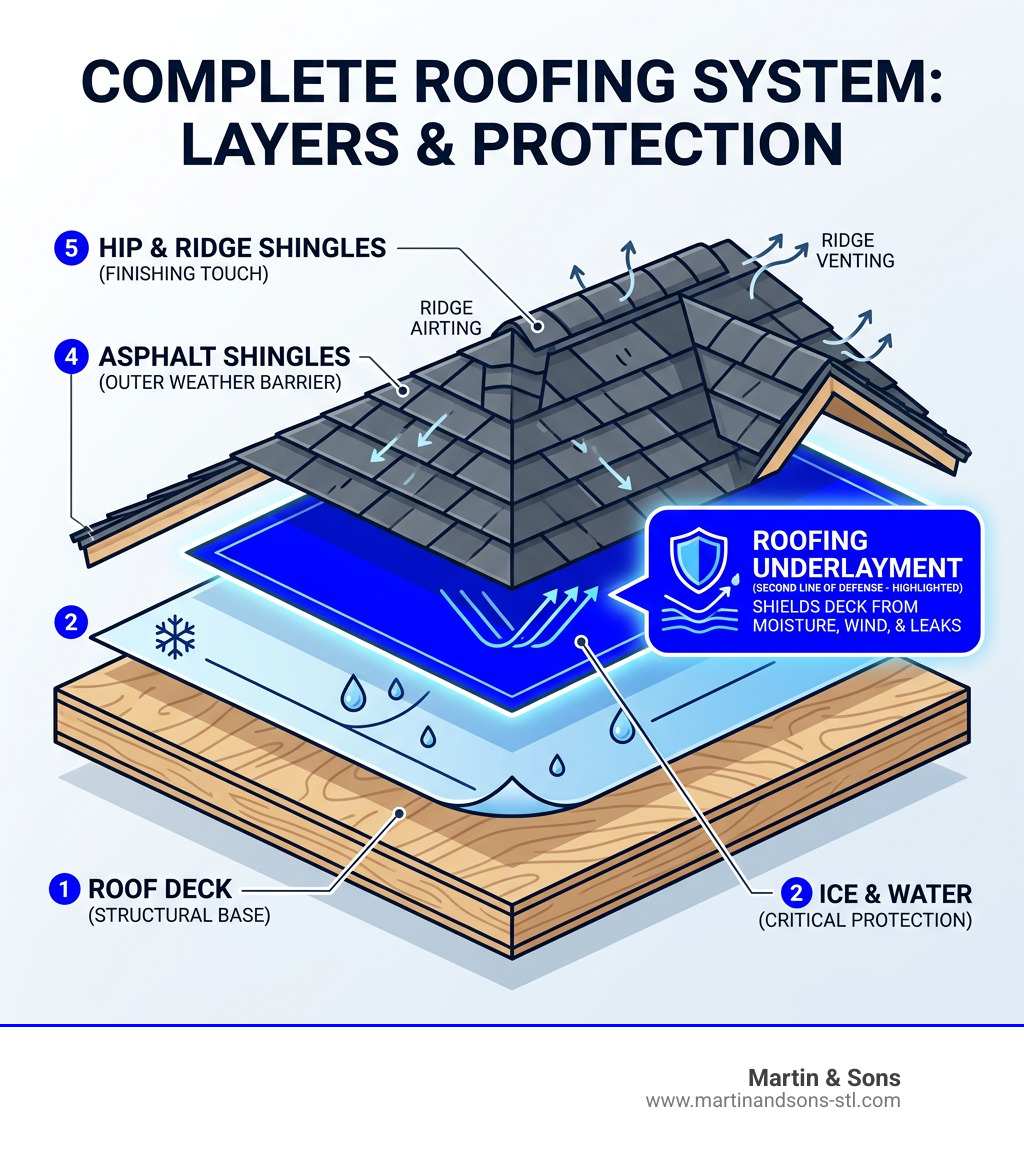
Roofing underlayment replacement vocab explained:
Think of your roof shingles as the “armor” and the underlayment as the “waterproof skin” underneath. Even the best-installed shingles can’t stop every drop of water, especially during a St. Louis thunderstorm or a heavy winter freeze.
Your Secondary Defense System
Underlayment is a water-resistant or waterproof barrier installed directly onto your roof deck. Its primary job is to act as a backup. If wind-driven rain gets forced under your shingles or if an ice dam forms at your eaves, the underlayment catches that moisture and directs it off the roof rather than letting it soak into your wooden decking. How roofing underlayment protects your home is by providing this critical layer of security that shingles alone cannot offer.
Protection During Installation and Beyond
During a roofing underlayment replacement, the underlayment also protects your home while the shingles are off. If a surprise rain cloud rolls over Chesterfield or O’Fallon while our crew is working, a high-quality underlayment keeps your attic dry.
Beyond weather, it is essential for:
- Building Codes: Most local municipalities in Missouri require a code-approved underlayment.
- Manufacturer Warranties: Shingle manufacturers often require specific underlayment to keep your warranty valid.
- Mold Prevention: By keeping the wood deck dry, it prevents the mold in your roof that can compromise your family’s health.
- Fire Resistance: Many synthetic underlayments carry a Class A fire rating, adding an extra layer of safety.
We always remind homeowners that a roof inspection is important to prevent damage because we can often spot underlayment failure before it rots your structural beams.
Types of Underlayment for Different Roof Systems
Choosing the right material for your roofing underlayment replacement depends on your roof type and budget. In the Midwest, we deal with extreme temperature swings—from humid 100-degree summers to sub-zero winters—which means your underlayment needs to be tough.
| Underlayment Type | Best For | Lifespan | Key Benefits |
|---|---|---|---|
| Asphalt-Saturated Felt | Budget-friendly shingle roofs | 10–20 Years | Traditional, breathable, inexpensive |
| Synthetic Underlayment | Most modern shingle & metal roofs | 20–30+ Years | Tear-resistant, UV stable, mold-resistant |
| Rubberized Asphalt | Low slopes, valleys, eaves | 25–30+ Years | Self-healing, 100% waterproof, “Peel-and-Stick” |
Asphalt-Saturated Felt (Tar Paper)
This is the “old school” choice. It comes in 15-lb and 30-lb weights. While it works, it can become brittle over time and is prone to tearing during high winds. In our roofing and siding replacement in Fenton, MO, we find that older felt often fails before the shingles do.
Synthetic Underlayment
Synthetic is the modern standard. Made from woven polypropylene or polyethylene, it’s incredibly strong. You can’t tear it with your hands, and it doesn’t absorb moisture. It can also stay exposed to the sun for up to 180 days without degrading, which is a huge plus for complex projects.
Rubberized Asphalt (Ice and Water Shield)
This is a premium “peel-and-stick” product. It’s essential for “critical zones” like valleys, chimneys, and eaves. Because it’s rubberized, it seals around the nails driven through it, creating a truly watertight bond. This is your best defense against the ice dams common in St. Louis winters.
Step-by-Step Guide to Roofing Underlayment Replacement
Replacing underlayment isn’t just about rolling out new paper. It’s a surgical process that requires attention to detail.
1. Preparation and Removal
First, we remove the old roofing material. Whether it’s shingles or tiles, they must be cleared away to reveal the old underlayment. We then strip the old felt or synthetic layer right down to the wood. Never install new underlayment over old layers—it traps moisture and hides damage.
2. The Critical Deck Inspection
Once the deck is bare, we perform a thorough “health check.” We look for:
- Rot and Soft Spots: Any wood that gives under pressure must be replaced.
- Nail Pops: We hammer down any loose nails to ensure a flat surface.
- Structural Damage: Understanding the lifespan of your home’s roofing starts with a solid foundation. If the plywood is delaminating or sagging, we fix it now. New roof sheathing typically costs between $2 and $5 per square foot.
3. Installing the New Underlayment
We start at the eaves (the lowest point) and work our way up. This “shingle-lap” method ensures that water always flows over the seams, not under them.
- Horizontal Overlaps: We maintain at least a 4-inch overlap between rows.
- Vertical End-Laps: These should be overlapped by at least 6 inches and staggered by 6 feet to prevent leak paths.
- Fastening Patterns: For synthetic underlayment, we use plastic cap nails. These provide a better seal and prevent the material from tearing off in high winds.
- Drip Edge: We install the underlayment over the drip edge at the eaves to ensure water goes straight into your gutters.
4. Special Areas and Safety
Valleys and penetrations (like chimneys and vents) get an extra layer of protection, usually a rubberized asphalt membrane. Safety is our top priority; we use harnesses and roof anchors, especially on steep-slope homes in Creve Coeur or Chesterfield.
Cost Factors and Professional Considerations
When planning a roofing underlayment replacement, the “sticker price” is influenced by several factors.
Breaking Down the Costs
- Average Cost: Most homeowners spend around $3,300, with a typical range between $1,700 and $4,200.
- Labor: Labor accounts for 80% to 90% of the total cost. It’s a physically demanding job that requires specialized skills.
- Roof Pitch: Steeper roofs are more dangerous and take longer to navigate, which increases the labor price.
- Materials: Material-only prices per square (100 sq. ft.) range from $5–$55 for felt to $50–$75 for premium rubberized asphalt.
You can learn more about roof installation costs and key factors that affect pricing to help you budget accurately.
DIY vs. Professional Replacement
While we love a good DIY project, roofing underlayment is rarely one of them. If you miss a single overlap or fail to seal a vent properly, you could face thousands of dollars in water damage. Plus, professional installation is usually required to maintain your shingle warranty. Hiring a pro also ensures you get the necessary permits (typically $150–$500 in the St. Louis area).
The good news? A full roof replacement, including new underlayment, offers a 50% to 70% return on investment (ROI) when it’s time to sell your home.
Frequently Asked Questions about Roofing Underlayment Replacement
Can I install new underlayment over the old layer?
We strongly advise against this. Installing new material over the old layer is a shortcut that often leads to disaster. It traps existing moisture against the wood deck, leading to rot. It also creates an uneven surface that prevents shingles from sealing properly and almost always voids the manufacturer’s warranty. Always strip it down to the deck so you can spot the signs of roof damage you should never ignore.
How long does roofing underlayment replacement typically take?
For an average residential home in St. Peters or Florissant, the project usually takes 2 to 4 days. However, if we find significant wood rot or if we encounter Missouri’s unpredictable weather, it may take up to a week. We always provide a clear timeline before we start so you know what to expect during your roof replacement.
What are the signs that my roofing underlayment replacement is necessary?
If your roof is over 15–20 years old, it’s likely time. Other red flags include:
- Interior Water Stains: Yellow or brown spots on your ceiling.
- Musty Odors: A sign of mold or mildew in the attic.
- Brittle Felt: If you can see the underlayment and it crumbles like a dry cracker, it’s failed.
- Curling Shingles: This often indicates the underlayment is no longer providing a smooth, dry base. Check out Martin & Sons LLC’s guide to common roofing problems for more details on what to look for.
Conclusion
Your home is likely your biggest investment, and the underlayment is the “unsung hero” that keeps it standing. Whether you are dealing with a small leak or planning a full renovation, getting your roofing underlayment replacement right is the difference between a roof that lasts 30 years and one that fails in ten.
At Martin & Sons, we’ve built our reputation across St. Louis, St. Charles, and O’Fallon by doing things the right way. We offer no upfront deposits—you only pay when you are 100% satisfied with the completed project. Plus, our lifetime labor warranties mean you can sleep soundly knowing your home is protected.
Don’t wait for a ceiling stain to tell you there’s a problem. Schedule a roof maintenance consultation with us today, and let’s make sure your home’s second line of defense is as strong as it can be.