Why Commercial Roofing Maintenance Is a Business Asset, Not Just an Expense
Commercial roofing maintenance is the practice of regularly inspecting, cleaning, repairing, and protecting your commercial roof to extend its lifespan and prevent costly failures.
Here are the 5 best practices covered in this guide:
- Schedule routine professional inspections (at minimum, twice per year)
- Manage drainage and remove debris consistently
- Protect the membrane with coatings and sealants
- Keep detailed maintenance records for warranty compliance
- Have an emergency response plan and annual budget in place
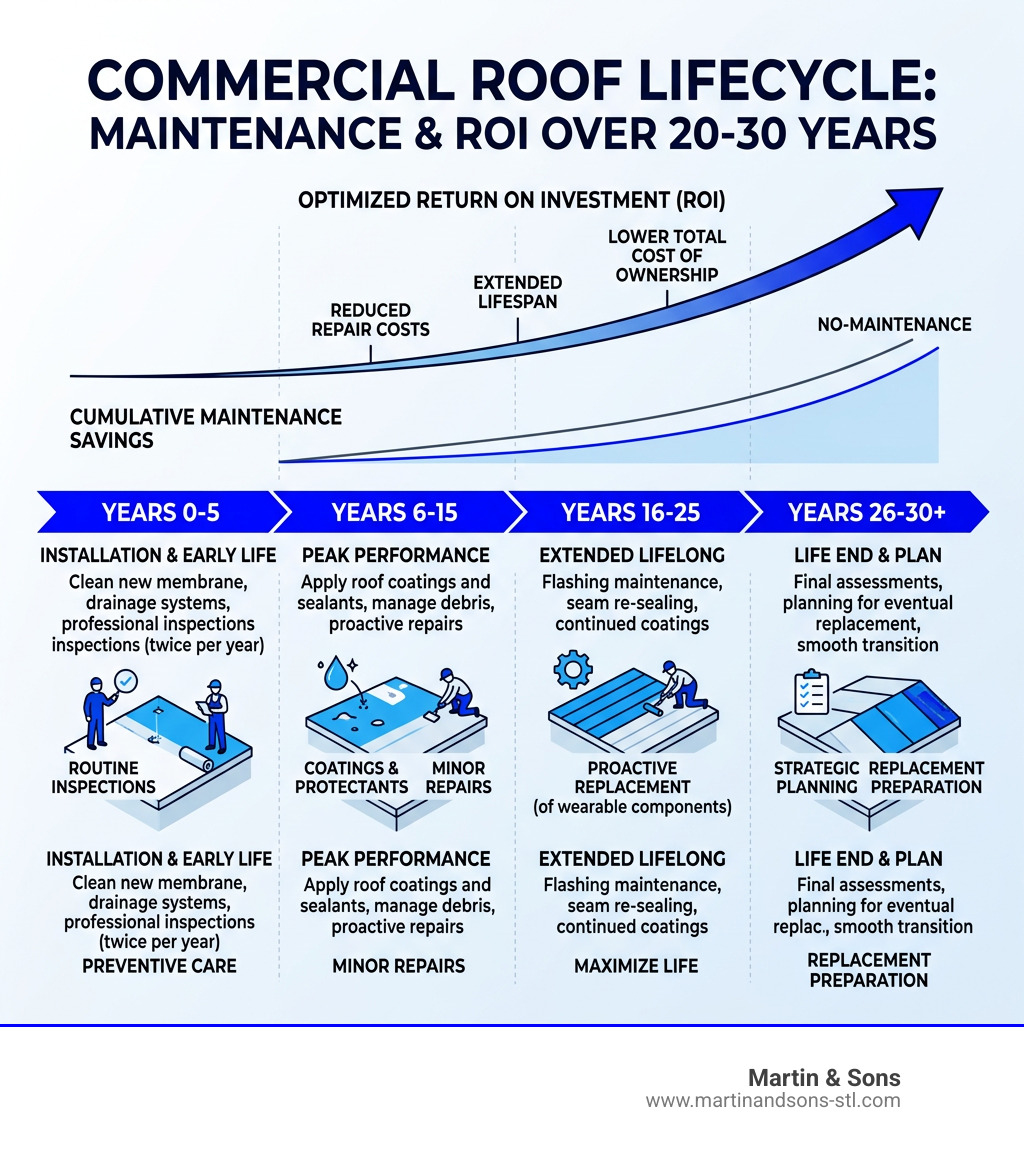
Most commercial roofs are built to last 20 to 30 years. But without consistent upkeep, that lifespan can be cut in half. Regular maintenance can also reduce repair costs by as much as 50% compared to a reactive, fix-it-when-it-breaks approach.
The math is straightforward: small, scheduled investments now prevent large, unplanned expenses later.
Most commercial roofs don’t fail because they’re old. They fail because small problems go unnoticed.
That’s the core idea behind everything in this guide.
I’m John Martin, and along with my family, I’ve spent over 35 years in the roofing industry helping property owners protect their buildings through honest, quality-first commercial roofing maintenance. The practices we’ll cover below are the same ones we apply every day on the job.
Commercial roofing maintenance further reading:
1. Prioritize Routine Commercial Roofing Maintenance Inspections
When it comes to your building’s overhead protection, “out of sight, out of mind” is a dangerous philosophy. We recommend a bi-annual schedule—specifically in the spring and fall. In the St. Louis and St. Charles areas, our roofs take a beating from heavy spring rains and the freezing-thawing cycles of winter. Spring inspections catch damage from winter ice, while fall inspections ensure the system is ready for the next cold snap.
Beyond the calendar, post-storm assessments are vital. After a significant hail event or high-wind storm in Florissant or O’Fallon, a quick check can identify loose materials before the next rain turns a small tear into a major leak.
At Martin & Sons, we believe a Roof Inspection Is Important To Prevent Damage. While many companies offer a quick glance, a true professional assessment should be comprehensive. We often perform a detailed 100-point inspection to evaluate every square inch of the surface.
It’s also worth noting that the roofing industry has a failure rate of over 50%, often due to a lack of specialized knowledge. This is why we emphasize working with highly qualified contractors. For example, only 2% of roofers in the U.S. qualify to be recognized as GAF Master Elite™ Contractors—a standard that ensures the person on your roof actually knows what they are looking for.
Identifying Common Signs of Roof Deterioration
During these inspections, we look for red flags that indicate your roof is struggling. Identifying these early is the cornerstone of effective commercial roofing maintenance.
- Ponding Water: If water remains on a flat roof for more than 48 hours after a rain, you have a drainage issue. This standing water adds immense structural load and accelerates membrane degradation.
- Membrane Punctures: Often caused by dropped tools from HVAC technicians or wind-blown debris, these small holes are the primary entry point for moisture.
- Blistering: These look like bubbles under the roof surface. They occur when moisture gets trapped between the layers of the roof and expands as it heats up.
- Surface Erosion: On asphalt-based roofs, look for “bald spots” where granules have washed away, leaving the underlying material vulnerable to UV rays.
- Seam Separation: This is a classic sign of age or poor installation. When seams pull apart, the roof is essentially wide open to leaks.
By catching these Signs Of Roof Damage You Should Never Ignore, you can opt for a simple repair rather than a full-scale replacement.
2. Master Your Drainage and Debris Management
If there is one thing that kills a commercial roof faster than anything else, it’s water that can’t find its way off. Proper drainage is the single most critical task for any low-slope or flat roof.
Clogged scuppers, gutters, and drains act like a dam. When water backs up, it finds the path of least resistance—which usually leads straight into your warehouse or office. Regular gutter cleaning and clearing of downspouts should be done at least quarterly, and certainly after the leaves fall in places like Chesterfield or Creve Coeur.
Vegetation removal is another overlooked step. We’ve seen roofs in Maryland Heights where small trees have actually started growing in the silt collected in the corners. Roots are incredibly strong and can easily penetrate a roof membrane, leading to Major Problems Caused By A Leaky Roof In St Peters MO, including structural rot and mold.
| Maintenance Task | Est. Preventive Cost | Est. Water Damage Repair |
|---|---|---|
| Gutter & Drain Cleaning | $200 – $500 | $2,500 – $10,000+ |
| Debris Removal | $150 – $300 | $1,500 – $5,000 |
| Vegetation Clearing | $100 – $250 | $3,000 – $7,000 |
The Role of Proper Drainage in Commercial Roofing Maintenance
We follow the “48-hour rule”: a well-designed roof should be dry within two days of a rainfall. If it isn’t, the structural load of that standing water can lead to deck deflection—a fancy way of saying the roof starts to sag. Once the roof sags, it creates a deeper “bowl” for even more water to collect, creating a vicious cycle.
Ensuring that outflow areas are clear is just as important as the roof itself. If your downspouts dump water right at the base of the building, you’re trading a roof problem for a foundation problem. When we discuss Everything You Need To Know About Fixing Flat Roofs, we always emphasize that a roof is only as good as its ability to shed water.
3. Protect the Membrane with Coatings and Sealants
Your roof is in a constant battle with the sun. UV radiation is relentless, causing materials to become brittle, crack, and lose their elasticity over time. This is where protective coatings become a game-changer for commercial roofing maintenance.
Reflective coatings—often white or silver—act like sunscreen for your building. By reflecting solar radiation, they keep the roof surface significantly cooler. This doesn’t just extend the life of the membrane; it drastically improves energy efficiency. For businesses in St. Louis, this can mean a noticeable drop in air conditioning costs during our humid July and August months.
Whether you have a TPO, EPDM, or metal roof, restoration is often a viable alternative to replacement. For instance, The Benefits Of Restoring Your Metal Roof In Florissant MO include stopping rust in its tracks and sealing all those pesky fasteners that tend to back out over time due to thermal expansion (the way metal grows and shrinks with temperature changes).
Maintaining Penetrations and Flashings
Most leaks don’t happen in the middle of a flat roof; they happen at the edges and around things sticking out of the roof. HVAC units, vent pipes, and chimneys are all “penetrations” that require special attention.
- Pitch Pans: These are metal “boxes” around roof penetrations filled with a sealant. Over time, this sealant can shrink or crack, allowing water to seep down the pipe.
- Expansion Joints: These allow the building to move without tearing the roof. If the sealant in these joints fails, you have a major entry point for water.
- Pipe Boots: The rubber seals around smaller pipes can dry out and crack within 5-10 years, often much sooner than the rest of the roof.
Regular Maryland Heights Roofing Maintenance involves checking these high-risk areas and resealing them before they fail. It’s a small task that prevents a very large headache.
4. Maintain Detailed Documentation for Warranty Compliance
If you have a warranty on your commercial roof, read the fine print. Almost every manufacturer guarantee requires you to perform—and document—regular commercial roofing maintenance. If you have a leak but haven’t had a professional inspection in three years, the manufacturer may have the right to deny your claim.
Effective record-keeping is your best defense. We recommend keeping a digital or physical log that includes:
- The original installation date and materials used.
- Full photo reports from every bi-annual inspection.
- Invoices for every repair, no matter how small.
- A “map” of the roof showing where repairs have been made.
When you know exactly What to include in a commercial roof maintenance plan, you turn your roof from a mystery into a managed asset. This documentation is also invaluable if you ever decide to sell the property or if you need to file an insurance claim after a storm.
How Documentation Supports Commercial Roofing Maintenance Strategy
Beyond just legal protection, a repair history helps you spot trends. If you find yourself repairing the same corner of the roof every year, there’s likely an underlying structural or drainage issue that needs a permanent fix.
This data also allows for smarter budgeting. By Understanding The Lifespan Of Your Home’s Roofing (or your commercial building’s roofing), you can predict when a replacement will be necessary. Instead of being blindsided by a $50,000 bill, you can plan for it five years in advance.
5. Establish an Emergency Response and Budgeting Plan
Even the best-maintained roof can suffer an emergency. A fallen tree limb or a severe St. Louis hailstorm can cause immediate damage. When that happens, you don’t want to be scrambling to find a contractor. Part of your commercial roofing maintenance strategy should be having a 24/7 service provider on speed dial who can offer quick leak mitigation to protect your inventory and operations.
Financially, we recommend businesses budget approximately $0.75 to $1.50 per square foot annually for comprehensive maintenance. For a 10,000-square-foot facility, that’s $7,500 to $15,000 a year. While that might seem like a lot, compare it to the cost of a full replacement, which can easily run $10 to $15 per square foot or more if there is significant deck damage.
When deciding between a patch job or a bigger project, you have to weigh the Repair Vs Replace How Do I Know Which Route To Take For My Roof. Usually, if more than 25% of the roof is damaged or the insulation underneath is saturated with water, replacement is the more cost-effective long-term move.
Operational protection is the goal. A leak over a server room or a retail floor isn’t just a roofing problem; it’s a business-stoppage problem. A proactive plan ensures your business keeps running, rain or shine.
Frequently Asked Questions about Commercial Roof Care
How often should a commercial roof be professionally inspected?
We recommend biannual inspections—once in the spring and once in the fall. This allows you to address damage from the previous season and prepare for the next. Additionally, you should always schedule an inspection after any severe weather event, such as high winds or hail. Check out our guide on How Often Should I Schedule A Roof Inspection Why Is It Important for more details.
Does regular maintenance affect my roof warranty?
Yes, absolutely. Most manufacturers require proof of regular maintenance to keep the warranty valid. Neglecting your roof can lead to a “voided” warranty, leaving you responsible for the full cost of repairs that might otherwise have been covered. This is a key part of Florissant Roofing Maintenance programs.
What is the most critical maintenance task for flat roofs?
Drainage management is number one. Because flat roofs don’t have the benefit of a steep slope, they rely entirely on drains, scuppers, and gutters. Keeping these clear of debris and ensuring there is no ponding water is the most effective way to prevent leaks. Learn more about O’Fallon Roofing Maintenance specific to flat systems.
Conclusion
At Martin & Sons, we understand that your commercial property is a major investment. Whether you are located in St. Louis, St. Peters, or Maryland Heights, our mission is to provide you with the most reliable commercial roofing maintenance services in the region.
We do things differently here. We require no upfront deposits—you only pay when the job is 100% complete and you are totally satisfied. Plus, our lifetime labor warranties and upfront pricing mean you never have to worry about hidden costs or shoddy workmanship.
Don’t wait for a drip from the ceiling to tell you there’s a problem. Protect your assets and your bottom line by being proactive. For expert St Louis Roofing Maintenance, trust the family that’s been doing it right for over three decades.
Schedule your professional commercial roof assessment today and let us help you get the most out of your roof.