
Understanding the True Cost of Vinyl Window Replacement in 2026
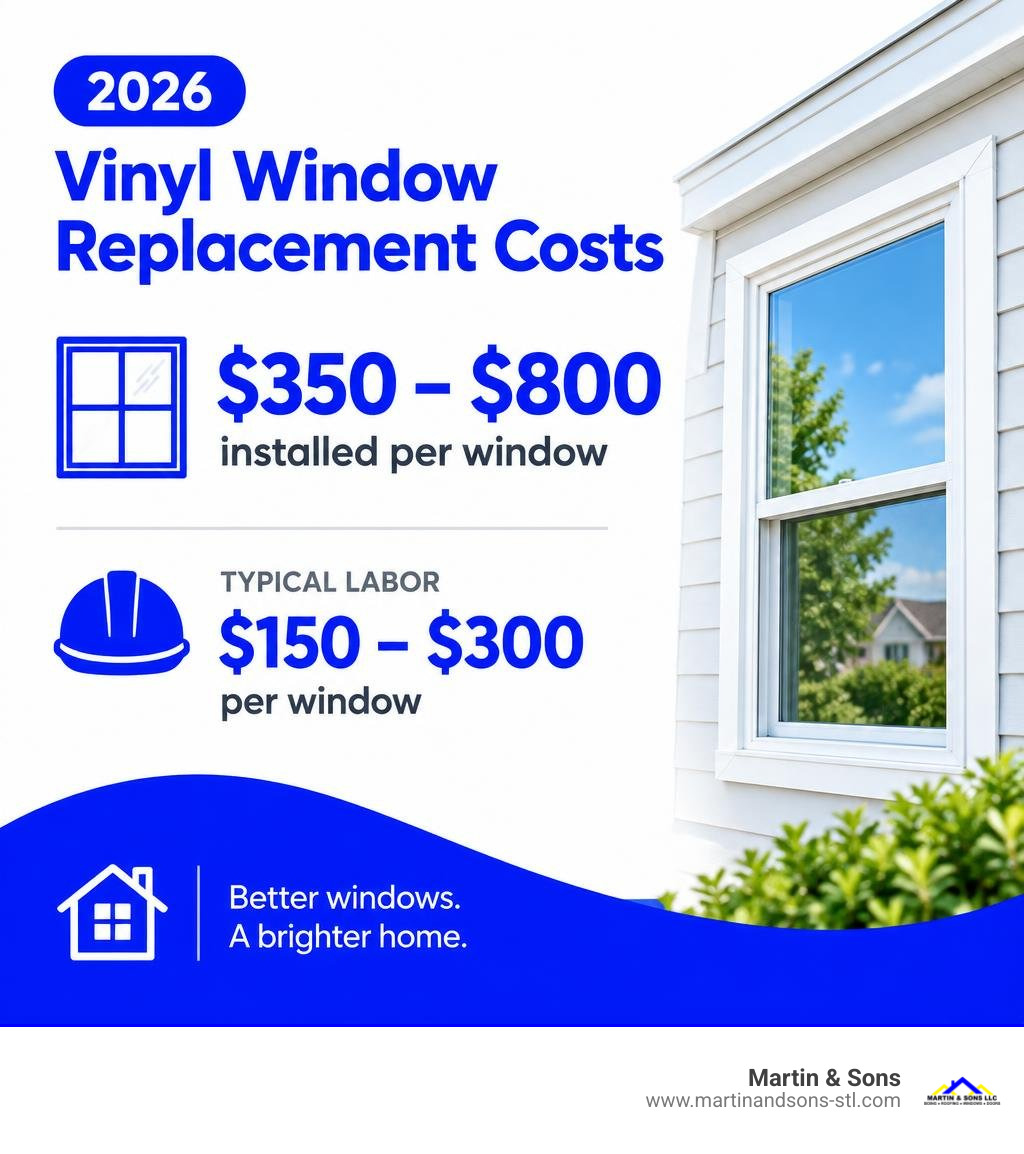
In 2026, the cost of vinyl window replacement is typically $350 to $800 per installed window, with an average of about $575. For a quick budget, multiply the number of windows by that range: replacing 10 windows would cost roughly $3,500 to $8,000. Standard installation labor often accounts for $150 to $300 per window. Your final quote will depend on window size, style, glass, and whether the existing frames need repairs.
I’m John Martin of Martin & Sons, a family-owned St. Louis home improvement business started in 1953. With over 35 years in the industry, I know the cost of vinyl window replacement is easier to judge when you can see what goes into the price.
Basic cost of vinyl window replacement glossary:
Modern vinyl windows are built using high-grade, 99% virgin vinyl with fusion-welded corners and multi-chambered internal extrusions. These honeycomb chambers trap dead air to provide natural thermal insulation while preventing frame sag. When properly installed, quality vinyl units deliver a lifespan of 20 to 40 years without rotting, peeling, or requiring repainting.
Average Cost of Vinyl Window Replacement by Window Style
Window design plays a major role in your overall project estimate. Simple operable sash designs cost far less than complex architectural units.
- Single-Hung Windows ($100 – $400 unit cost; $200 – $850 installed): Features a fixed top sash and an operable bottom sash. These represent one of the most economical choices for standard bedroom or living room openings.
- Double-Hung Windows ($150 – $650 unit cost; $429 – $915 installed): Both upper and lower sashes slide vertically and tilt inward for straightforward cleaning. Choosing double-hung vinyl window upgrades remains the most popular path for classic residential architecture.
- Sliding Windows ($150 – $800 unit cost; $775 – $1,652 installed): Sashes slide horizontally on durable brass or nylon rollers, making them ideal for wide openings and exterior walkways.
- Casement Windows ($150 – $1,000 unit cost; $597 – $1,273 installed): Hinged on one side and operated with a manual hand crank, casement windows crank outward to compress tightly against perimeter weatherstripping for exceptional draft prevention.
- Picture Windows ($65 – $700 unit cost; $250 – $900 installed): Because they are stationary and feature no mechanical balances or latches, large fixed picture units deliver high energy performance at a lower mechanical cost per square foot.
- Hopper & Awning Windows ($100 – $950 installed): Commonly installed in compact spaces like basements, hoppers swing inward from the top, while awnings swing outward from the top to allow ventilation during light rain.
- Bay and Bow Windows ($900 – $7,100+ installed): Multi-pane architectural projections that extend beyond exterior wall lines require custom framing, load-bearing cable support systems, and integrated roof skirts.
| Window Style | Average Unit Price | Average Installed Cost Range | Best Application / Features |
|---|---|---|---|
| Single-Hung | $100 – $400 | $200 – $850 | Budget projects, single-story openings |
| Double-Hung | $150 – $650 | $429 – $915 | Traditional homes, easy interior tilt-wash |
| Sliding | $150 – $800 | $775 – $1,652 | Wide horizontal openings, modern layouts |
| Casement | $150 – $1,000 | $597 – $1,273 | Maximum ventilation, airtight seal |
| Picture (Fixed) | $65 – $700 | $250 – $900 | Unobstructed views, optimal insulation |
| Awning / Hopper | $100 – $550 | $250 – $950 | Basements, bathrooms, rainy-day venting |
| Bay / Bow (3–5 lites) | $900 – $4,500+ | $1,700 – $7,100+ | Aesthetic focal points, deep seating nooks |
When comparing different window types and costs, balancing mechanical operation with thermal performance helps ensure you choose the best window for every room.
Material Comparisons: Vinyl vs. Wood, Aluminum, and Fiberglass
Homeowners frequently compare vinyl to natural wood, thermally broken aluminum, fiberglass, and composite frames. Reviewing the pros and cons of vinyl window materials highlights why vinyl accounts for the vast majority of replacement projects.
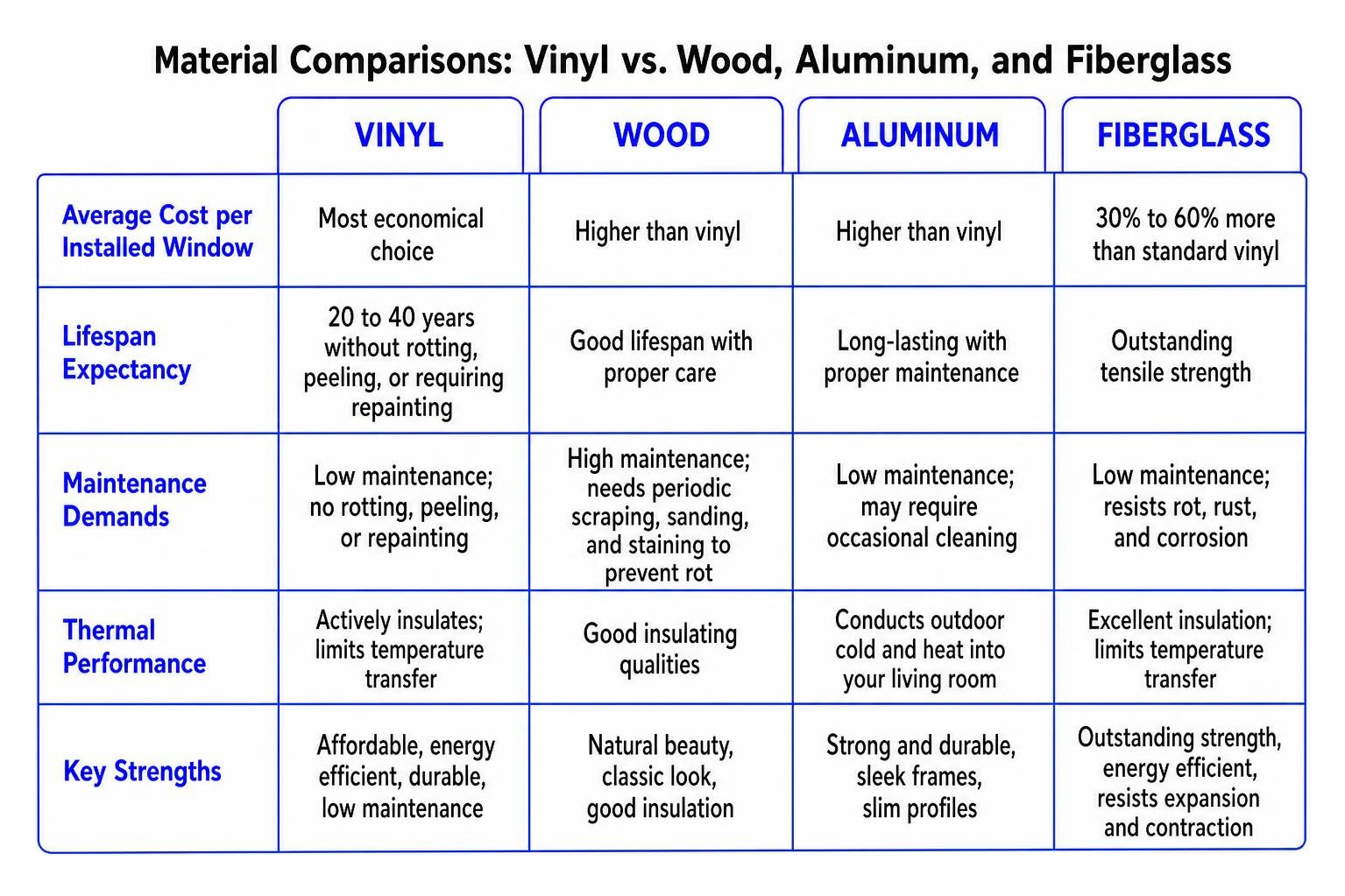
Vinyl is a thermoplastic polymer that acts as an effective thermal insulator. Unlike aluminum, which readily conducts outdoor cold and heat into your living room, vinyl frames limit temperature transfer. Natural wood offers good insulating qualities and traditional beauty, but it demands periodic scraping, sanding, and staining to prevent rot. Fiberglass and composite frames provide outstanding tensile strength, though they come with an upfront price premium of 30% to 60% over standard vinyl.
Independent data from the Fixr vinyl window installation pricing guide confirms how material choices shape baseline expenses:
| Frame Material | Average Cost per Installed Window | Lifespan Expectancy | Maintenance Demands | Thermal Performance |
|---|---|---|---|---|
| Vinyl | $350 – $800 | 20 – 40 Years | Very Low (Occasional soap & water) | High |
| Aluminum | $450 – $1,100 | 20 – 30 Years | Low (Prone to condensation/corrosion) | Poor to Fair |
| Composite | $500 – $1,800 | 30 – 40 Years | Low | High |
| Wood | $800 – $1,500+ | 30 – 50+ Years | High (Routine paint/stain upkeep) | High |
| Fiberglass | $900 – $1,500 | 35 – 50 Years | Very Low | Exceptional |
Key Factors and Labor Rates That Shape Your Total Price
The method used to install your new windows directly affects project labor and material totals:
- Pocket (Insert) Replacement: If your existing exterior trim and wood framing are square, solid, and free of moisture damage, installers insert a custom-measured vinyl frame directly into the existing master frame. This approach preserves your original interior woodwork and reduces labor expenses.
- Full-Frame Replacement: If the existing frame is rotted, out of plumb, or structurally compromised, technicians must strip the opening down to the bare rough framing studs. This requires new interior trim, exterior brickmould, and flashing tape, increasing total labor by $100 to $250 per opening.
High-quality vinyl frames are rated according to American Architectural Manufacturers Association (AAMA) standards. While baseline building codes call for a design pressure of 15 psf (77 mph wind resistance), premium residential vinyl windows regularly test at 35 to 50 psf, withstanding structural loads up to 141 mph. Custom orders tailored to exact rough openings typically require a manufacturing lead time of 4 to 6 weeks.
Estimating the Cost of Vinyl Window Replacement Labor and Supplies
Professional installation labor averages $150 to $300 per standard window, but can reach $800 per opening for oversized, second-story, or complex architectural installations.
As detailed in our breakdown of vinyl window replacement costs, labor covers precise trade tasks:
- Setting the custom vinyl unit into the prepared opening.
- Shimming the frame plumb, level, and square to prevent sash binding.
- Securing jambs with corrosion-resistant structural fasteners.
- Injecting low-expansion polyurethane foam insulation into perimeter voids.
- Sealing exterior gaps with premium commercial elastomeric caulking and custom-bent aluminum coil trim.
Beyond trade labor, project estimates routinely incorporate peripheral supply and administrative expenses, which are highlighted in the NerdWallet guide on replacement window costs and budgeting:
- Job Consumables ($25 – $50 per window): High-grade composite shims, flashing tapes, low-expansion foam, and color-matched sealants.
- Old Window Demolition & Disposal ($50 – $200 per opening): Safe removal of lead-weighted double-hung sashes, metal scrap handling, and regional landfill disposal fees.
- Municipal Building Permits ($50 – $300): Local municipal inspections required in St. Louis County, St. Charles, and surrounding communities.
Glass Packages, Energy Efficiency Upgrades, and Frame Features
The insulated glass unit (IGU) within the vinyl frame determines how well your home resists Missouri’s freezing winters and humid summers.
- Single-Pane Glass ($400 baseline installed): Rarely installed today due to high thermal conductivity and common condensation issues.
- Double-Pane Glass ($475 – $750 installed): The modern residential standard, featuring two panes separated by a sealed air gap with warm-edge spacers.
- Triple-Pane Glass ($600 – $1,200+ installed): Three panes of glass separated by two gas-filled chambers, offering superior sound dampening and thermal insulation.
- Low-Emissivity (Low-E) Coatings: Microscopically thin metallic layers applied to interior glass surfaces that reflect radiant infrared heat back indoors during winter and block solar UV rays during summer.
- Argon Gas Fills: Denser than ambient air, non-toxic argon gas is injected between glass panes to reduce convective heat transfer, achieving U-factors below 0.28.
- Color Finishes & Custom Laminates: Standard white vinyl is the most cost-effective. Choosing black, dark bronze, or painted exterior laminates adds a 20% to 50% price surcharge because of specialized manufacturing steps.
Upgrading to energy-efficient windows helps homeowners reduce their heating and cooling costs by an average of 12% to 13%, saving $125 to $350 or more each year on utility bills.
Maximizing Value and Long-Term Savings on Your Installation
A successful window replacement project balances upfront investments with long-term protection. During initial removal, installers may uncover hidden structural issues, such as moisture intrusion behind old siding or rotted wooden sills. Setting aside a 10% to 15% contingency fund helps cover any unexpected structural framing repairs without pausing construction.
Working with an experienced installation team also helps protect your product warranty. Leading manufacturers require certified installation practices to keep their 20-year to lifetime seal-failure warranties valid. At Martin & Sons, we support all our work with lifetime labor warranties, provide best pricing upfront, and follow a strict no upfront deposit policy—meaning you pay only when the job is 100% complete and you are fully satisfied. While we provide comprehensive roofing, siding, and window replacement, we are not a standalone gutter contractor and handle gutter installations exclusively alongside full roof replacements.
Whole-Home vs. Phased Projects: ROI and Bulk Cost Savings
Replacing multiple windows simultaneously is almost always more cost-effective than replacing them one or two at a time. Contractors encounter fixed mobilization costs—including transit, safety setup, drop-cloth placement, and dumpster rentals—on every trip.
When exploring the cost considerations when replacing multiple windows, homeowners who group 5 to 15 windows into a single installation project often secure per-unit labor discounts of 10% to 20%.
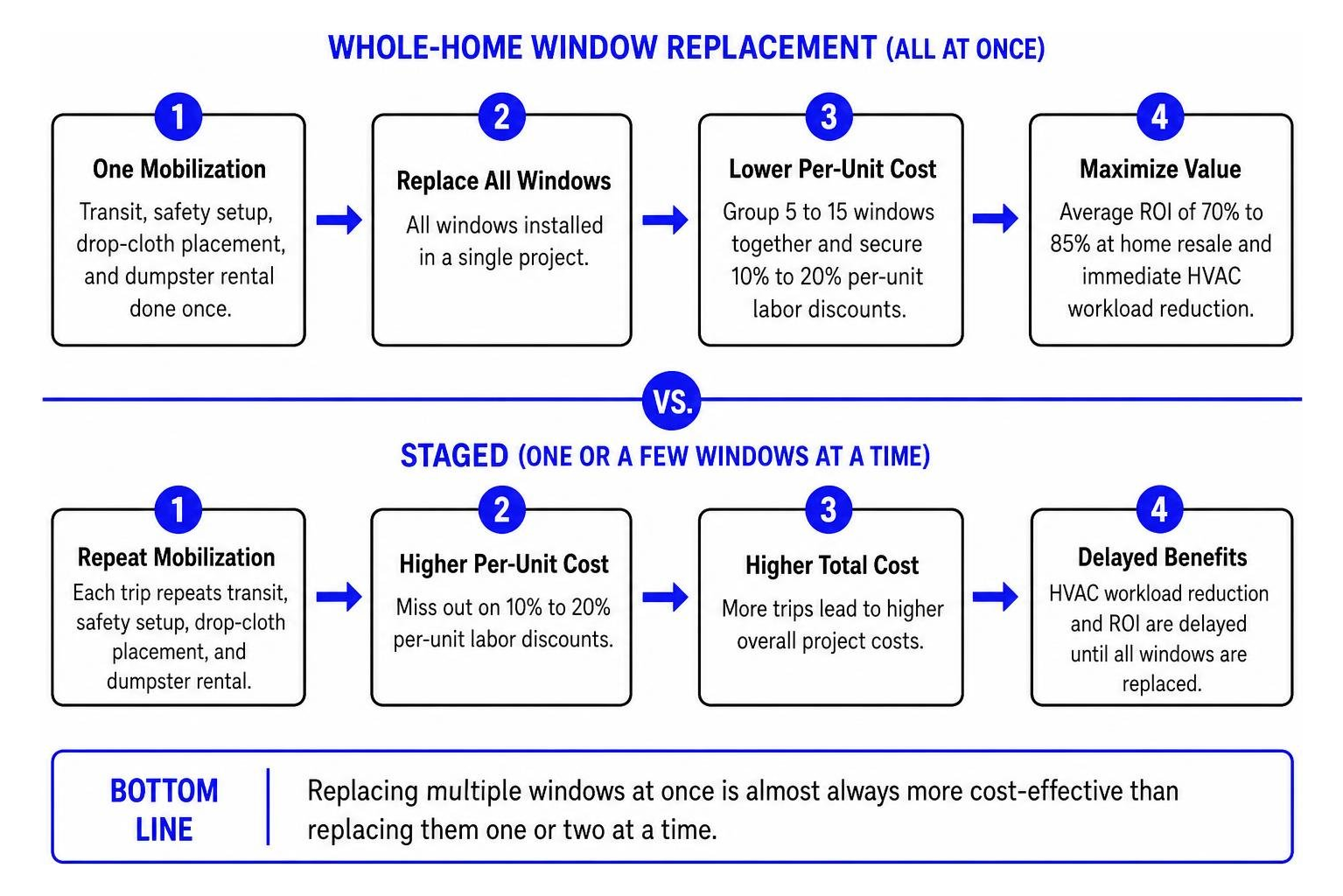
From an investment standpoint, residential window replacements yield an average return on investment (ROI) of 70% to 85% at home resale. Whole-home installations also immediately reduce the workload on your HVAC system, helping keep temperatures consistent across every room.
Smart Strategies to Save on Your Window Project
- Stick to Standard Manufacturer Dimensions: Ordering standard prefabricated dimensions avoids the 30% to 50% surcharges associated with custom structural modifications.
- Prioritize Problem Openings: If a full whole-home replacement is outside your immediate budget, prioritize drafty north-facing elevations or visibly failing, rotted frames first.
- Take Advantage of Federal Tax Credits & Utility Rebates: Installing qualifying Energy Star windows can make you eligible for federal clean energy tax credits (up to $600) alongside local electric and gas utility rebates.
- Schedule Flexible Project Dates: Booking projects during mild spring or autumn windows can sometimes help you secure attractive seasonal contractor incentives.
- Partner with a Reputable Local Installer: Avoid high-pressure sales bids and choose established, locally licensed teams that stand behind their craftsmanship.
To evaluate custom installation variables for your home in St. Louis, St. Peters, St. Charles, Florissant, Chesterfield, Creve Coeur, Maryland Heights, or O’Fallon, review the key factors affecting window replacement pricing and get a free, detailed, zero-deposit quote tailored to your property.