
Understanding the Average Cost of Vinyl Replacement Windows in 2026
When planning your home improvement budget, understanding the baseline cost of vinyl replacement windows gives you a solid foundation for evaluating quotes. In 2026, the national average installed cost for a single vinyl replacement window sits around $575, with most standard projects landing comfortably between $450 and $800 per window.
For a complete home transformation, a whole-house project involving 10 to 15 vinyl windows generally runs between $6,500 and $18,650 installed. This wide range accounts for differences in window styles, custom sizes, and overall structural requirements. If you want a complete breakdown of broader project estimates, check out The Ultimate Guide to Window Replacement Cost to see how various scope factors shape total project invoices.
Labor plays a substantial role in these totals. Professional glazier and carpentry labor averages $150 to $300 per window, representing roughly 40% to 50% of your total invoice. Here in the St. Louis area, including communities like St. Peters, Florissant, and O’Fallon, labor costs reflect skilled regional trade rates while offering competitive value compared to coastal markets.
Factors That Influence the Cost of Vinyl Replacement Windows
Why does one vinyl window quote come back at $450 while another hits $900? Several distinct variables dictate final pricing:
- Window Size and Sizing Type: Standard prefabricated sizes straight from the factory are the most budget-friendly. Custom dimensions or oversized window openings can add a 30% to 50% surcharge to the base unit price.
- Glass Package and Efficiency Options: Single-pane glass is virtually obsolete. Modern standard units feature double-pane glass with insulating argon gas fills. Upgrading to triple-pane glass boosts energy efficiency significantly but increases glass material costs by about 30% to 80%.
- Low-E Coatings: Microscopic metallic layers reflect infrared and ultraviolet light. Adding Low-E (low-emissivity) coatings adds a minor upfront charge but yields substantial ongoing utility savings.
- Frame Customization & Colors: Standard extruded white vinyl is the most cost-effective. Choosing interior woodgrain laminates or dark exterior finishes (like trendy black or bronze frames) requires specialized solar-reflective formulations and manufacturing processes, bumping frame costs up by 15% to 30%.
- Hardware and Grids: Custom muntins, internal grid patterns, and premium lock hardware subtly increase total per-unit prices.
To dive deeper into what moves the needle on pricing, review the Top 8 Factors That Affect Replacement Window Prices.
Cost of Vinyl Replacement Windows by Quality Tier
Not all vinyl windows are constructed identically. The market divides into three clear tier levels:
- Builder-Grade ($150 – $400 Installed): Basic vinyl windows often featuring mechanically fastened corners rather than fully welded joints. They usually rely on thin-walled hollow vinyl profiles and basic glass packages. While cheap upfront, they carry shorter lifespans and lower thermal resistance.
- Mid-Range ($400 – $700 Installed): The sweet spot for most homeowners. These units feature thick, fusion-welded multi-chamber vinyl frames, double-pane Low-E glass, argon gas fills, and robust tilt-in sashes for easy cleaning.
- Premium Grade ($700 – $1,000+ Installed): Premium vinyl windows incorporate internal polyurethane foam insulation within the frame chambers, high-performance warm-edge spacer systems, impact resistance option upgrades, and advanced multi-point locking mechanisms. Brands like Simonton or upper-tier series from Pella lead this category.
For home improvement newcomers trying to decide which tier fits their long-term plans best, our Beginners Guide to Window Replacement Cost provides additional clarity.
Installed Vinyl Window Costs by Style
The mechanical design and operation style of a window strongly impact both its unit cost and the labor needed to set it in place.
| Vinyl Window Style | Material Cost Range | Total Installed Cost Range | Typical Lifespan | Best Use Case |
|---|---|---|---|---|
| Double-Hung | $150 – $550 | $300 – $850 | 20 – 30 Years | Traditional homes, multi-story bedrooms |
| Single-Hung | $100 – $300 | $250 – $600 | 20 – 30 Years | Budget-conscious projects, main floor |
| Casement | $200 – $600 | $300 – $900 | 20 – 30 Years | Max ventilation, hard-to-reach spots (sinks) |
| Sliding | $150 – $500 | $250 – $800 | 20 – 30 Years | Wide openings, ranch-style homes |
| Picture (Fixed) | $100 – $450 | $200 – $750 | 25 – 35 Years | Pure daylight, non-vented feature openings |
| Bay or Bow | $1,000 – $4,500 | $1,500 – $6,500+ | 20 – 30 Years | Living rooms, architectural curb appeal |
Whether you are updating a single room or facing the real-world math of a major house project, line-item details matter. Read our breakdown on Cost to Replace 17 Windows Real World Estimates vs Sticker Shock to see how window style variations impact full estimates.
Labor Expenses and Installation Complexity
Installation labor typically ranges from $150 to $300 per unit, but complex conditions can drive rates toward $500–$800 per opening. Two primary installation methods determine where your project will land:
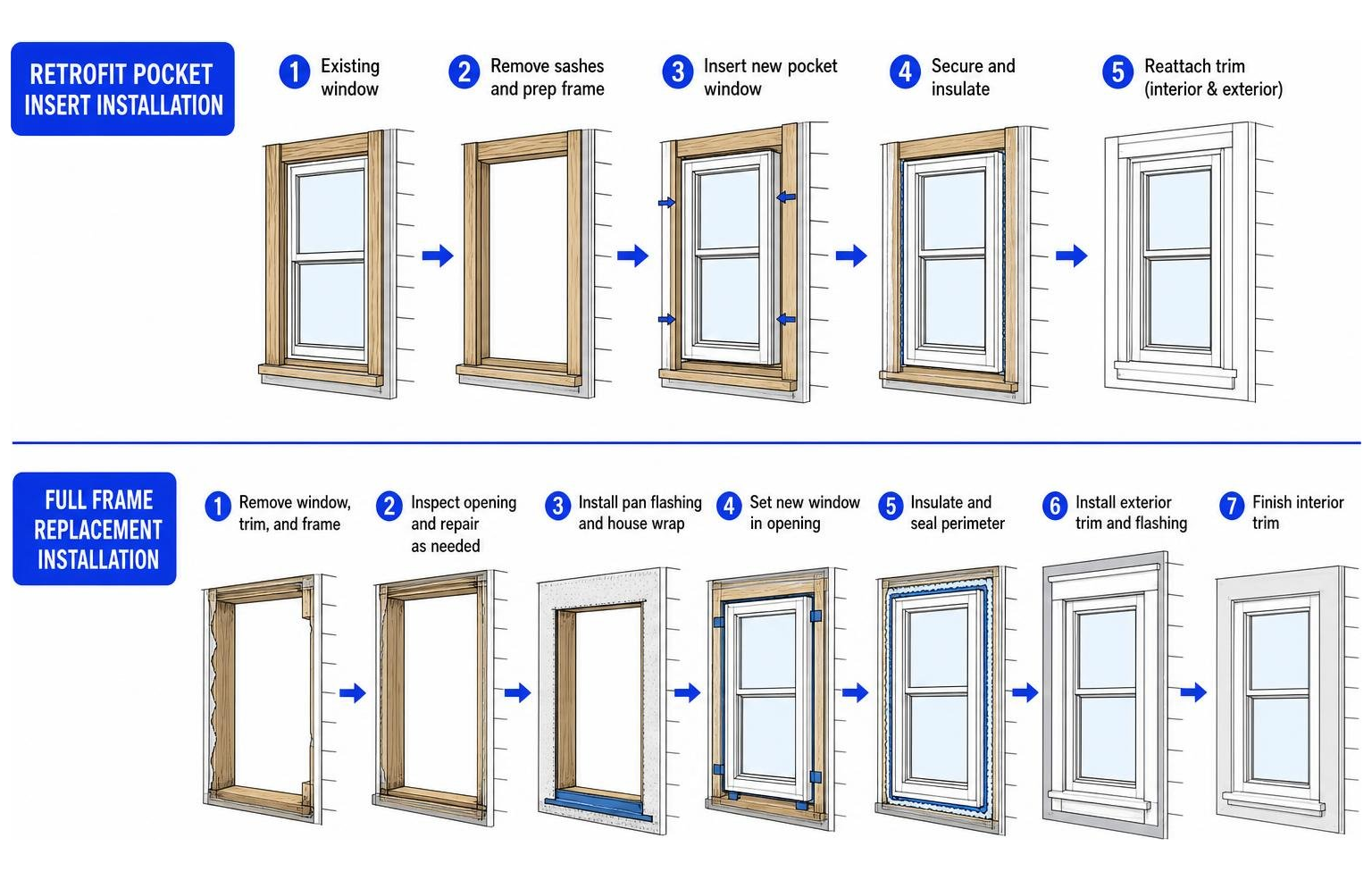
- Retrofit Pocket Insert Installation: If your existing interior and exterior wood trim is structurally sound, square, and free from decay, installers slide a custom pocket insert directly into the existing frame. This preserves existing trim, takes around 1 to 2 hours per window, and keeps labor costs closer to $150–$250 per unit.
- Full-Frame Replacement: If old frames are rotted, out-of-square, or drafty, installers strip everything down to the rough stud opening. They install new pan flashing, house wrap integration, exterior trim capping, and insulation. Full-frame installs add $150 to $350 in labor per window.
Hidden Surprise Costs: Approximately 30% of retrofit window projects reveal underlying framing or sill rot once old units are pulled. Fixing rotted studs or water damage can add $300 to $1,500 to the total job. Furthermore, installations on second or third floors requiring scaffolding, or work involving lead paint containment in pre-1978 homes, naturally increase labor overhead.
Pros, Cons, and Long-Term Value of Vinyl Windows

Vinyl windows (constructed from rigid polyvinyl chloride, or PVC) hold 55% of the market because they balance performance and price better than almost any alternative frame material. However, they aren’t without limits.
Advantages of Vinyl Windows
- Moisture and Rot Resistance: Unlike wood, vinyl never absorbs water, swells, rots, or decomposes. This makes it ideal for humid Midwest summers in places like Chesterfield and Maryland Heights.
- Low Maintenance: Vinyl frame color is uniform throughout the material. You never need to scrape, prime, paint, or stain them. Cleaning requires only warm water and mild dish soap.
- High Thermal Efficiency: Vinyl is a natural insulator with low thermal conductivity, preventing exterior heat or cold from transferring into your living quarters.
- Cost Advantage: Vinyl supply units run 40% to 60% cheaper than wood and 20% to 40% less than fiberglass.
Disadvantages of Vinyl Windows
- Non-Paintable Surface: Standard paint does not adhere well to PVC. If you change your exterior house colors years down the road, you cannot easily paint white vinyl frames.
- Thermal Expansion: PVC expands and contracts in response to rapid temperature swings more than fiberglass or glass itself. Over 20+ years, extreme expansion cycling can eventually break perimeter caulking or put stress on glass seal edge spacers.
- Wider Profiles: Vinyl frame profiles are thicker than sleek aluminum or fiberglass frames, slightly reducing total glass viewing area.
If you are weighing vinyl against wood or composite frames, browse The Complete Guide to Vinyl Windows and review our deep dive on Vinyl Windows What Are the Pros and Cons of This Material.
Energy Savings and Resale ROI
Upgrading aging single-pane or failing double-pane windows to ENERGY STAR certified vinyl windows yields noticeable daily comfort improvements and clear financial returns:
- Utility Bill Reductions: Replacing drafty single-pane windows with modern Low-E vinyl double-pane units can cut annual home heating and cooling energy usage by 12% to 13%, saving homeowners roughly $300 to $780 per year depending on square footage and energy habits.
- Resale Cost Recovery: According to long-term remodeling cost versus value data, vinyl replacement windows consistently return over 73% of their installation cost in added equity upon home resale. Buyers appreciate updated, maintenance-free envelope systems.
Smart Ways to Save Money on Vinyl Window Replacement
Replacing windows is a significant home investment, but smart planning allows you to maximize every dollar spent:
- Replace in Bulk (Whole-House Discounting): Replacing 10 to 15 windows in a single contract saves 10% to 20% compared to doing two or three windows at a time. Contractors save on mobilization, permit setup, and disposal logistics, passing those volume savings on to you.
- Stick to Standard Prefabricated Sizes: Architectural designs featuring custom arched tops or non-standard dimensions jump in material price by up to 50%. Where possible, utilize standard manufacturer catalog sizes.
- Choose Double-Pane Low-E over Triple-Pane in Moderate Climates: While triple-pane glass is fantastic for severe Arctic weather zones, standard double-pane glass with argon gas meets ENERGY STAR criteria in the Midwest at a much lower price point, delivering a faster payback period.
- Plan Off-Peak Scheduling: Late fall and winter scheduling can sometimes unlock seasonal labor flexibility compared to peak late-spring rush seasons.
- Request All-Inclusive transparent Bids: Ensure disposal fees ($50–$200/window), permit charges ($50–$300), and exterior aluminum trim capping are spelled out in writing up front so sticker shock doesn’t hit halfway through the job.
Review our dedicated Window Replacement Tips for Your Next Home Project for more budget-friendly advice, check out What to Consider When Replacing Your Windows, and learn what to expect during installation by reading Out With the Old Step by Step Vinyl Window Replacement.
Frequently Asked Questions About Vinyl Window Replacement
How long do vinyl replacement windows typically last?
Quality mid-range and premium vinyl windows typically last 20 to 30 years. High-end vinyl windows with foam-filled profiles and warm-edge spacers can operate effectively for 30 to 40 years with simple upkeep. Insulated glass unit (IGU) seals usually remain airtight for 15 to 20 years before inert gas gradually dissipates. Regular track cleaning and avoiding harsh chemical solvents help maximize frame seal lifespans.
Is it cheaper to replace all home windows at once or in phases?
Replacing all home windows at once is significantly cheaper per unit. A contractor’s fixed overhead costs—such as trip fees, scaffolding setup, dumpster rentals, and municipal permitting—are spread across a single project. Bulk ordering also secures volume discounts on materials, yielding a total project cost savings of 10% to 20% compared to phasing the job across multiple years.
What is the average ROI for upgrading to vinyl replacement windows?
Vinyl window replacements consistently rank among the top exterior home improvement upgrades for return on investment, recouping approximately 73% of project costs at home resale. Beyond immediate market equity, homeowners benefit from lower monthly utility bills, reduced HVAC system wear, quieter indoor environments, and zero frame painting costs.
Conclusion
When evaluating the cost of vinyl replacement windows, vinyl remains the undisputed value leader for residential window replacement in 2026. Offering an unbeatable blend of thermal performance, long-term durability, zero maintenance, and attractive resale value, vinyl frames make premium home upgrades accessible.
At Martin & Sons, serving homeowners throughout St. Louis, St. Charles, Creve Coeur, Florissant, and surrounding communities, we take the stress out of home exterior remodeling. We stand firmly behind our consumer-first promise: no upfront deposits required. You don’t pay a single penny until your window installation is 100% complete and you are totally satisfied with the craft. Paired with our lifetime labor warranties and transparent pricing, you can upgrade your home’s envelope with absolute peace of mind.
Ready to explore your window options with a local team you can rely on? Read our guide on finding The Best Vinyl Window Installers for a Maintenance Free Life or Explore vinyl window benefits and features with Martin & Sons to schedule your free, no-pressure project estimate today!